
How Military Pressure Leads to Release of 10 Captives, Surrender of Terrorists and 12 Rifles in Kwara as Video sparks Controversy
By: Zagazola Makama
The release of 10 kidnapped victims and the recovery of 12 rifles from surrendered terrorists following sustained military pressure on armed groups around Gbugbu Forest in Edu Local Government Area of Kwara State have been overshadowed by controversy surrounding a video showing troops receiving surrendered bandits, which was subsequently misinterpreted on social media.
The video, circulated by a social media commentator known as The Moon, prompted questions about the activities of the Nigerian Army and the Department of State Services (DSS), with the commentator urging Nigerians to demand explanations from the security agencies over what he portrayed as an engagement with bandits.
The premature exposure of a sensitive surrender operation by a social media commentator draws attention to the consequences of sensationalism, operational security and the growing tendency to misrepresent painstaking security operations.
There is a dangerous difference between demanding accountability from security institutions and recklessly discrediting their operations without understanding what is happening behind the scenes. Unfortunately, a recent social media commentary on the ongoing security operations in Kwara State appears to have crossed that line.
A video showing troops of the Nigerian Army receiving surrendered terrorists around Gbugbu Forest in Edu Local Government Area of Kwara State has generated controversy after it was circulated online by a social media commentator known as The Moon, who questioned what the military and the Department of State Services (DSS) were doing with bandits.
His commentary, urging Nigerians to demand answers from the Army and DSS, presented an incomplete picture of what was, in fact, a sensitive and classified security operations involving efforts to secure the release of kidnapped victims, recover weapons and receive top bandits armed bandits elements who were willing to abandon violence to surrender.
What the video did not explain was that the military and intelligence operatives were not necessarily conducting a conventional assault operation at that particular moment. They were engaged in a non-kinetic process designed to achieve objectives that could have been considerably more difficult, costly and dangerous through direct confrontation. And this is where the misinterpretation becomes particularly troubling.
Zagazola understands that the video was recorded at about 2:00 p.m. on November 13, when three prominent terrorist figures operating around Gbugbu Forest Auta Ilori, Dan Karemi and Ori Gambali indicated their willingness to surrender to security forces, submit their weapons and release captives held in their custody.
The development followed sustained military pressure on the armed group through ongoing operations under Operation SAVANNAH SHIELD.
Troops had maintained pressure around Gbugbu Forest and adjoining areas, restricting the operational freedom of the criminal elements and creating conditions for engagement through non-kinetic channels.
The first phase of the process produced tangible results. Twelve rifles of different types were recovered, while 10 kidnapped victims were successfully released from captivity.
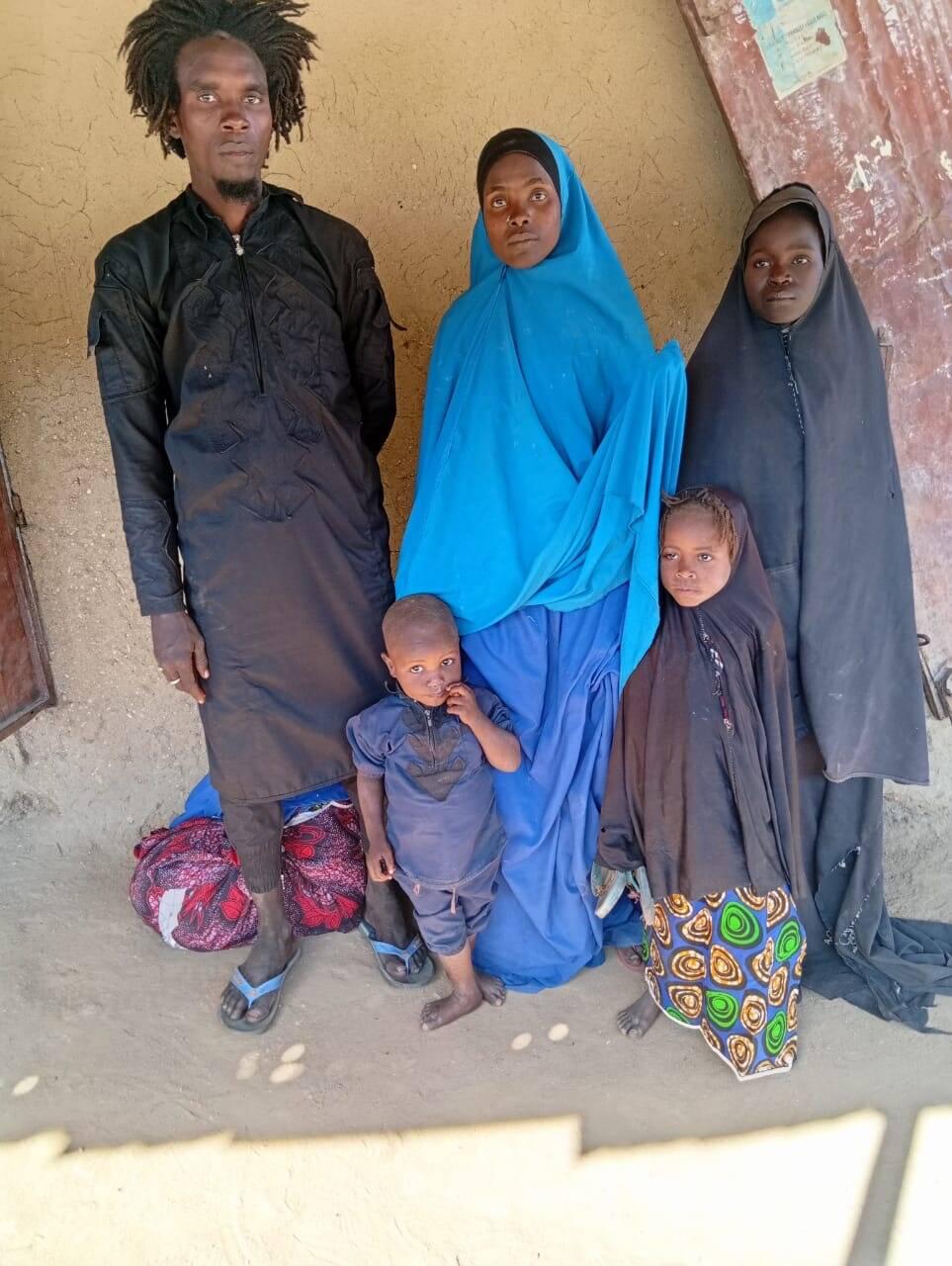
Zagazola has also obtained photographs and video footage of some of the rescued victims, providing further evidence that the engagement had produced concrete results.
The rescued victims and recovered weapons were subsequently taken into military custody, while many of the armed fighters agreed to surrender by submitting their weapons through
the surrender process.
In other words, while some commentators were busy interpreting the footage through the lens of suspicion, the security agencies were pursuing an ongoing process that had already resulted in the recovery of weapons and the freedom of 10 people.
One of the most persistent misconceptions about counterterrorism and counterinsurgency operations is the assumption that military effectiveness must always be measured by the number of terrorists killed or the volume of gunfire exchanged. That is a dangerously simplistic understanding of modern security operations.
Military operations involve both kinetic and non-kinetic approaches. Kinetic operations involve the use of force, including raids, air interdictions, ambushes and direct engagements. Non-kinetic operations, on the other hand, employ intelligence, psychological pressure, community engagement and other measures to weaken armed groups and achieve security objectives without necessarily resorting to immediate violence. And when terrorists indicated their willingness to surrender, military will have no choice but to accept. This was enshrined in accordance with the laws of armed conflict and the rule of engagement.
Both approaches are legitimate instruments of national security when conducted within the law and under appropriate command and control.
In situations where kidnappers or armed criminal groups express willingness to release captives and surrender weapons, refusing to explore such an opportunity simply because it does not produce battlefield footage would be an irresponsible approach.
Consider the 10 kidnapped victims recovered in the first phase of the Kwara engagement.
These are 10 human beings who have been given an opportunity to return to their families without the additional risks that could accompany a military assault on their captors. A direct assault on a forest hideout where kidnapped persons are being held could expose them to crossfire, reprisals or execution by their captors.
That does not mean military force should never be used. It means commanders must assess the circumstances, weigh the risks and choose the approach most likely to protect innocent lives while achieving the mission.The recovery of 12 rifles is equally significant. Every weapon removed from the possession of armed criminal networks represents a reduction in their capacity to inflict violence on communities and security personnel.
The objective is not to give criminals a platform or reward their crimes. It is to dismantle their operational capacity, secure the freedom of victims and bring those responsible within the reach of the law.
The danger of exposing a sensitive security operation
Perhaps the most disturbing aspect of this controversy is not merely the commentary itself but the apparent exposure of footage from an operation that was still ongoing. The video was reportedly recorded by personnel involved in the engagement and subsequently found its way into public circulation. This highlights troubling issues surrounding operational security and discipline within the ranks.
Not every military operations is intended for public consumption. Some operations require confidentiality, particularly where intermediaries are involved, captives remain in danger and negotiations have yet to reach their conclusion.
The premature publication of such footage can undermine trust, expose intermediaries, compromise intelligence sources and potentially provide armed groups with information about the security agencies' approach.
More importantly, it can put the lives of the very people the military is trying to rescue at risk.
Imagine a situation where captors who have agreed to release some victims suddenly discover that their engagement with security forces has become a subject of public ridicule, speculation and political pressure. Such exposure could harden their position, trigger distrust and jeopardise the release of additional captives.
It could also expose troops and intelligence personnel involved in the process to threats and retaliation. This is why operational security is not a public relations inconvenience. It is a critical component of mission success. There is a reason military authorities do not disclose every intelligence lead, every contact with armed groups or every tactical decision while an operation is underway.
It is therefore fundamentally unfair to take a few minutes of footage from a complex security engagement, strip it of its operational context and present it as evidence that the Army and DSS are fraternising with bandits or failing to perform their responsibilities.
The remaining process, according to security sources, was still ongoing at the time of filing this report and at the time the video was still circulating. It is therefore particularly irresponsible to pronounce judgment on an operation before its conclusion, especially when the people whose lives depend on its success may still be in danger.
Nigeria's security forces operate under enormous pressure, often in difficult terrain, with threats that are not always visible to the public.
Behind every successful operation are intelligence assessments, surveillance, operational planning, coordination, risks to personnel and decisions that may determine whether hostages return home alive.
The public rarely sees these complexities.
What many people see are short videos, dramatic photographs and social media commentaries that reduce complicated security operations to a few seconds of footage. This culture of instant judgment is becoming a serious problem.
There is nothing wrong with demanding transparency from the military. Indeed, the armed forces must communicate their achievements, explain their actions and remain accountable to Nigerians. But transparency should not be confused with the reckless disclosure of sensitive operational details. Neither should public criticism be based on deliberately or inadvertently misleading interpretations of events.
A kidnapped person rescued without a bullet being fired is just as valuable as a terrorist neutralised in a military assault. Twelve rifles recovered through intelligence-led engagement are no less significant than weapons seized during a battlefield raid.
The families of the 10 rescued victims will probably not be concerned about whether their loved ones were released through a gun battle or negotiations. What matters to them is that their relatives are alive and coming home.
That should be the priority.
The man who circulated the video and questioned the Army and DSS may have intended to demand accountability, but accountability without context can easily become misinformation, while reckless exposure of an ongoing operation can have consequences far beyond social media arguments.
It is important to understand that the military is not conducting operations to entertain social media audiences. Its primary responsibility is to protect lives, defend the country and neutralise threats to national security. Sometimes, the most consequential victories in counterterrorism are achieved not by pulling the trigger, but by creating the conditions that make the gun unnecessary.
Zagazola Makama is a counter-insurgency and security analyst.