From Mega Schools to Specialist Hospitals, Yobe Showcases Seven Years of Transformation Under Buni
By: Zagazola Makama
Over the last seven years, the administration of Gov. Mai Mala Buni has pursued an aggressive development agenda aimed at rebuilding institutions, improving public services and creating economic opportunities across Yobe State.
From education and healthcare to agriculture, housing, water supply and governance reforms, the administration says it has continued to implement policies and projects designed to improve the living conditions of residents and position the state for long-term growth.
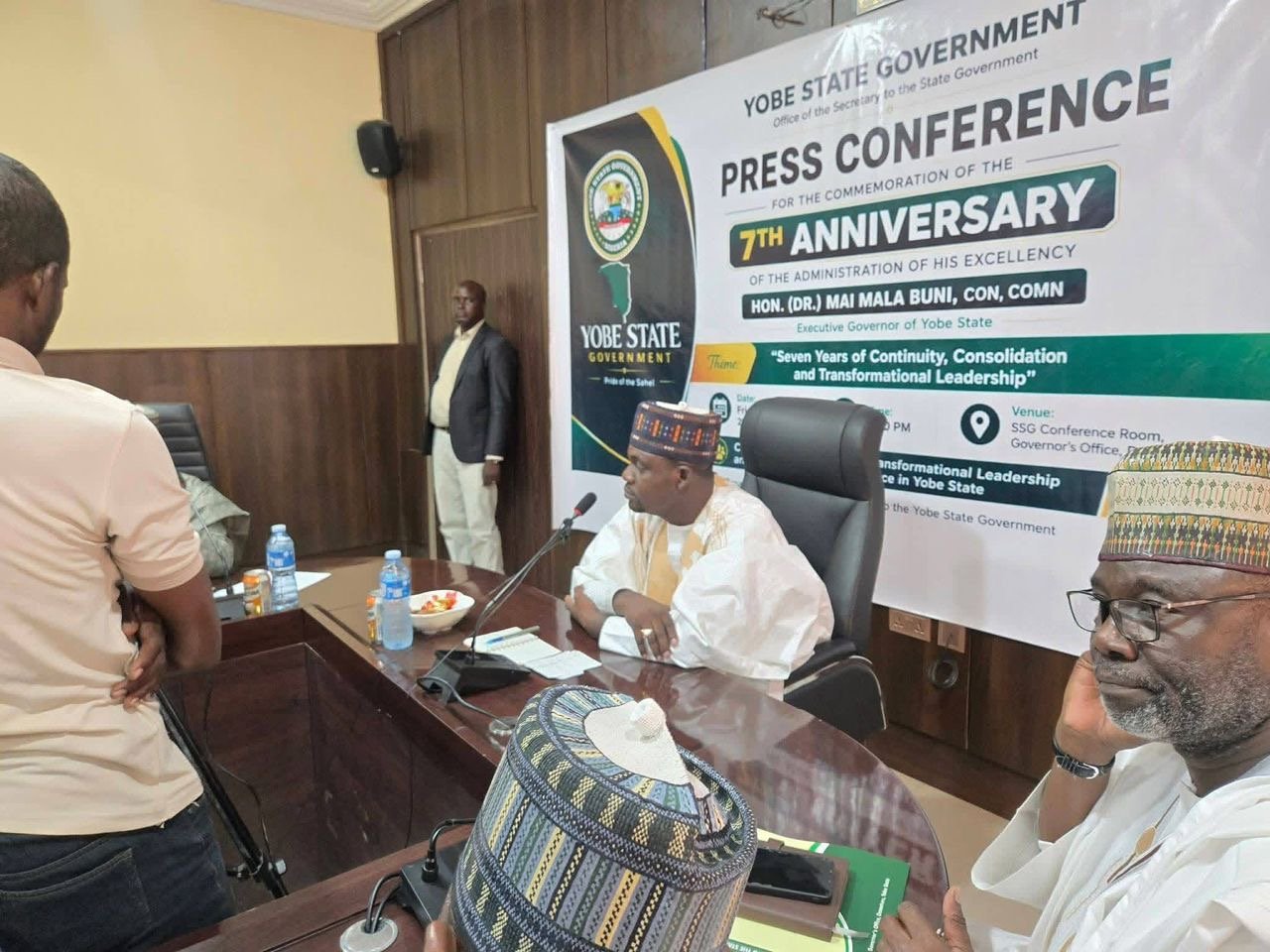
The Acting Secretary to the State Government (SSG), Dr Mohammed Goje, highlighted the achievements on Friday during a press conference marking the seventh anniversary of the administration in Damaturu.
According to him, the administration has prioritised human capital development as a critical foundation for sustainable development.
Goje described education as the administration’s “most strategic investment in the future,” noting that significant resources had been committed to expanding access to quality learning across the state.
He said the government constructed seven Mega Schools and seven Model Schools in different parts of the state to improve learning environments and address growing enrolment demands.
The administration also expanded infrastructure at Yobe State University and established the Clinical Section of the Medical College to strengthen medical education and manpower development.
Goje added that the College of Nursing and Midwifery was strengthened while technical institutions received upgrades to support science, technology and vocational education.
According to him, the administration also promoted girl-child education, upgraded secondary schools and expanded tertiary education infrastructure across the state.
“Importantly, over 48,000 students currently benefit from government scholarship programmes in universities, polytechnics, colleges of education, nursing institutions and specialised training institutions within and outside Nigeria,” he said.
The scholarship scheme has become one of the largest educational support programmes in the state, easing financial burdens on families and increasing access to higher education for many young people.
The administration believes the investments are laying the foundation for a skilled workforce capable of driving future economic growth and innovation in Yobe. Beyond education, the government also recorded major interventions in the healthcare sector.
Goje said the sector had witnessed unprecedented expansion under the Buni administration through the construction and upgrade of healthcare facilities across the state.
He disclosed that government completed 143 out of the 178 focal Primary Healthcare Centres located across political wards in the state.
The administration also upgraded five General Hospitals to Specialist Hospitals and established additional General Hospitals to improve access to advanced medical services.
To strengthen maternal and child healthcare, government constructed 300-bed capacity Mother and Child Referral Centres while also expanding critical infrastructure at the Yobe State University Teaching Hospital (YSUTH) and other medical facilities.
The administration further established the Yobe State Drugs and Medical Consumables Management Agency (YODMA) with an initial investment of over N2.3 billion to ensure regular supply of essential medicines.
Goje said the intervention had strengthened drug availability in health facilities and improved healthcare delivery across the state.
He also said the Yobe State Contributory Healthcare Management Agency (YSCHMA) currently provides health insurance coverage to more than 350,000 residents.
According to him, the programme has made healthcare more affordable and accessible, especially for vulnerable residents.
“These interventions have significantly improved healthcare access, referral systems, maternal and child health services, and specialist medical care,” he said.
Agriculture and economic development also featured prominently among the administration’s priorities.
As a predominantly agrarian state, Yobe depends heavily on farming and livestock activities for livelihoods and local economic growth.
Goje said the administration convened a historic Agricultural Summit and developed the state’s first Agricultural Policy to provide direction for agricultural transformation.
He stated that government distributed 7,500 metric tonnes of subsidised fertiliser to farmers and provided an additional 1,500 metric tonnes for irrigation farming.
The administration also procured more than 100 tractors to support mechanised agriculture and established livestock development centres and pastoral infrastructure.
According to him, the interventions were designed to improve productivity, strengthen food security and support farmers across the state.
Government also invested in commerce and industry through the construction of modern markets, motor parks and agro-processing facilities.
Goje said previously moribund industries such as the Potiskum Flour Mill and Aluminum Company had also been revived under the administration.
He added that sesame processing and packaging factories established in Damaturu, Potiskum, Machina and Nguru were supporting farmers, creating jobs and strengthening agricultural value chains.
In efforts to address unemployment and youth empowerment, the administration established the Ministry of Wealth Creation, Empowerment and Employment Generation.
Through the ministry, thousands of youths and women benefited from empowerment programmes involving vocational equipment and productive assets.
Beneficiaries received irrigation pumps, tricycles, sewing machines, GSM repair kits, grinding machines and other tools to support entrepreneurship and self-reliance.
Economic analysts believe such interventions could help reduce unemployment and stimulate small-scale business activities across communities. The administration also made significant investments in housing and basic infrastructure.
Goje said government delivered more than 2,350 housing units across the state, including 1,000 housing units in Damaturu.
He explained that the houses were provided with a 50 per cent subsidy to make home ownership more affordable for ordinary citizens.
In the water sector, government implemented projects aimed at expanding access to potable water in urban and rural communities. The projects include the Machina Water Reticulation Project, Buni Gari Water Treatment Plant and the construction and rehabilitation of hundreds of boreholes across the state.
Residents in several communities have reported improved access to clean water as a result of the interventions. Similarly, government expanded rural electrification projects to reconnect communities to the National Grid and improve economic activities.
Communities such as Gulani, Gujba, Kanamma, Wachakal, Koriyel, Shekau, Garga, Dumsai, Sumsumma and Rugar Fulani benefited from electrification and reconnection projects. The administration says the interventions have improved business activities, security and quality of life in the affected communities.
On governance and institutional reforms, Goje said the administration invested heavily in strengthening public institutions and improving service delivery.
Government rehabilitated the State Secretariat, reconstructed ministries and agencies and established new institutional facilities to modernise public administration.
The administration also strengthened public financial management systems and expanded digital governance through the Yobe Information Technology Development Agency (YITDA).
According to Goje, the reforms improved accountability, transparency and efficiency in government operations.
He added that investment promotion was enhanced through the establishment of dedicated institutions and agencies designed to attract investors and support economic growth.
“These reforms have improved service delivery, strengthened accountability, and enhanced the capacity of government institutions to serve citizens effectively,” he said.
Goje noted that the achievements highlighted during the press conference represented only a summary of projects and reforms implemented over the last seven years.
He said a comprehensive compendium containing details of projects, policies and measurable outcomes across sectors would be made available to journalists through the Commissioner for Information.
The SSG appreciated the support of residents, traditional and religious leaders, security agencies, development partners, civil servants, political stakeholders, youth and women groups toward the successes recorded by the administration.
“As we celebrate seven years of continuity, consolidation and transformational leadership, the administration remains committed to sustaining peace, accelerating economic growth, strengthening institutions, creating opportunities for our youth, and building a more prosperous future for all,” he said.