Niger incidents underline rising Sahel spillover threat to Nigeria’s security
By: Zagazola Makama
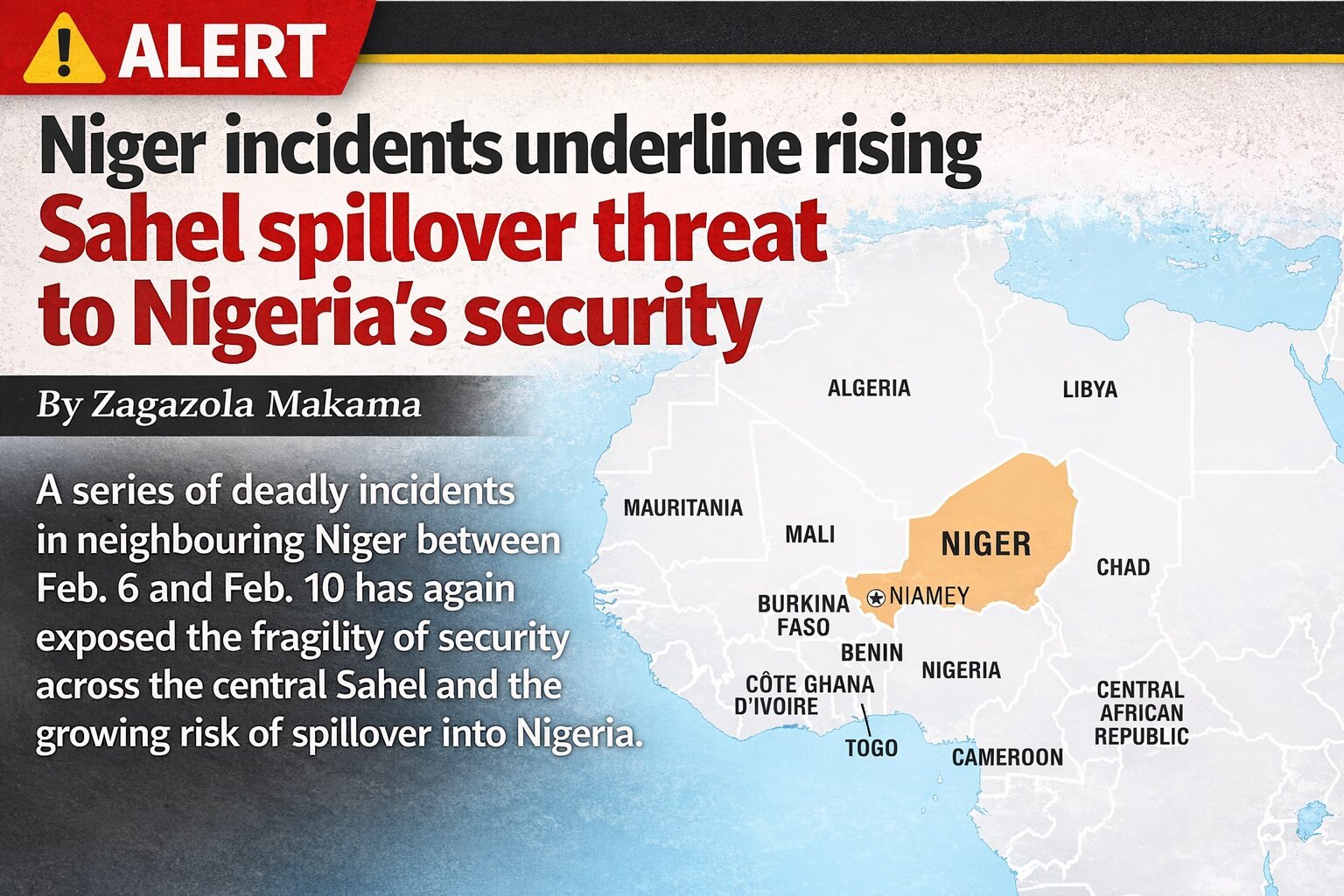
A series of deadly incidents in neighbouring Niger between Feb. 6 and Feb. 10 has again exposed the fragility of security across the central Sahel and the growing risk of spillover into Nigeria.
Zagazola report from the period show a grim pattern: an air raid that killed mostly civilians in Tillaberi Region; a mass abduction in Diffa Region near Nigeria’s border; and a roadside bomb attack that claimed at least 11 lives.
On Feb. 6, coordinated drone strikes hit a crowded market in Kokoloko, about 120 kilometres from Niamey. While the strikes were said to be aimed at terrorist elements, the outcome was devastating for civilians.
At least 17 civilians, including three minors, were killed, with only three terrorists reportedly neutralised. Several properties were destroyed in the fires that followed.
Two days later, suspected ISWAP elements invaded Gagamari Village in the Chettimari Commune of Diffa Region, just six kilometres from Gargada and close to Nigeria’s border. The attackers reportedly focused on youths, abducting about 28 males. On Feb. 9, the group released the youngest of the victims with a warning to authorities that they would return for more youths.
On Feb. 10, tragedy struck again when a commuter vehicle drove into a remotely emplaced improvised explosive device (RSBIED) lane at Baroua in Diffa. The blast killed a National Guard soldier on leave and 10 other passengers, destroying the vehicle.
These incidents reflect a broader and worrying trend: the steady southward creep of jihadist violence from the Sahel into West Africa’s coastal and near-coastal states. Niger’s security crisis is increasingly intertwined with developments in Mali and Burkina Faso under the Alliance of Sahel States (AES), whose withdrawal from ECOWAS and pivot to Russian Wagner mercenaries have reshaped regional security dynamics.
The resulting vacuum has been exploited by jihadist groups such as ISWAP and ISIS-linked elements, which are now linking operations across north-central Niger, Nigeria’s North-East and North-West, and through intermediaries in the Sahel.
The convergence is evident in recent atrocities, including the February 2026 massacre in Kwara State where JAS-linked extremists reportedly killed nearly 200 civilians, a signal that the threat is edging closer to Nigeria’s economic heartlands.
For Nigeria, reactive containment is no longer sufficient. A proactive, multi-layered strategy is required, one that combines hardened borders, pragmatic diplomacy and internal resilience.
Nigeria must accelerate border fortification with advanced surveillance, drone patrols and rapid-response units in high-risk corridors such as the Lake Chad Basin axis and the Sokoto–Kebbi route. Porous borders remain the main arteries for the flow of arms, fighters and logistics.
Abuja needs a recalibrated diplomatic posture. Bilateral intelligence-sharing pacts with AES regimes, even outside ECOWAS frameworks are essential to disrupt cross-border networks. Ongoing talks with the United States on drone logistics could provide technological leverage, but Nigeria must assert autonomy to avoid perceptions of external puppetry that fuel anti-Nigerian rhetoric in Sahelian propaganda.
Third, internal resilience is non-negotiable. Poverty, youth unemployment and governance deficits in border communities continue to feed recruitment and the spread of ransom camps from Borno to Kwara. Without visible improvements in livelihoods and local administration, security gains will remain fragile.
The Sahel now accounts for more than half of global terrorism deaths. If Nigeria does not move decisively on sealed borders, pragmatic diplomacy and socioeconomic fortification, it risks turning its northern frontiers into a permanent jihadist conduit.
The Niger incidents are not isolated tragedies. They are warnings. The window for preventive action is narrowing, and the price of delay will be paid in lives, stability and the future of regional integration in West Africa.
Zagazola Makama is a Counter Insurgency Expert and Security Analyst in the Lake Chad Region


