PLATEAU AT A CROSSROADS: HEALING OLD WOUNDS, RECONCILING DIFFERENCES AND EMBRACING A NEW FUTURE
By: Dr. Salim Musa Umar
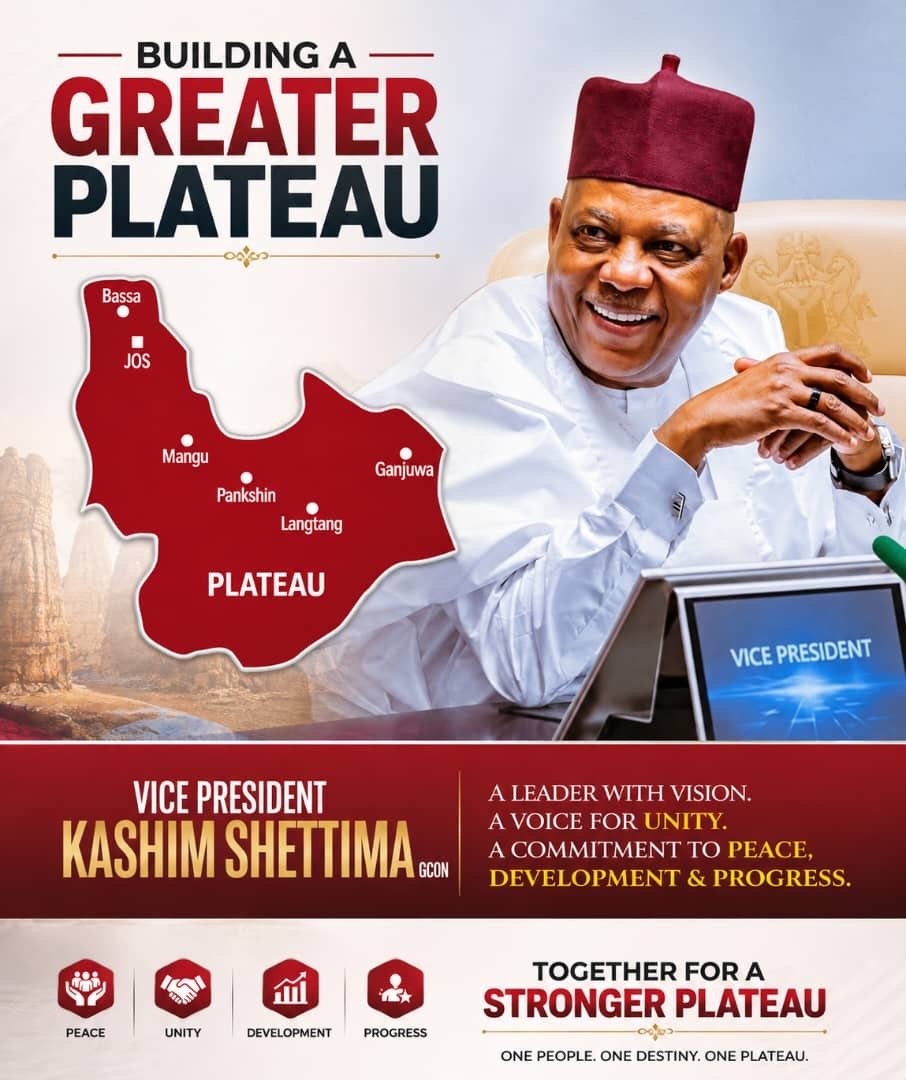
The recent message of the Vice President, Senator Kashim Shettima, during his visit to Jos deserves more than a passing political commentary. His call on the people of Plateau State, particularly the younger generation, to reject “inherited historical grievances” and embrace tolerance and peaceful coexistence strikes at the heart of one of the most difficult challenges confronting the State.
For more than two decades, Plateau has been caught in a painful cycle of violence, mistrust, displacement, reprisals and deeply entrenched suspicion among communities. Generations have grown up hearing narratives of victimhood, injustice and betrayal. In some cases, young people have inherited grievances from conflicts they did not witness and hatred against people they have never personally known.
This is precisely why the Vice President's message is important.
A society cannot build a peaceful future while continually importing the conflicts of its past into the lives of its children.
There is no denying that Plateau has experienced terrible tragedies.
Communities have suffered. Lives have been lost. Homes and livelihoods have been destroyed. Families have endured wounds that cannot simply be wished away. The memories of those who were killed or displaced must never be trivialised.
But remembering the past must not mean becoming prisoners of it.
There comes a time when a people must summon the courage to say: enough is enough.
Plateau needs a genuine process of healing, not a superficial appeal for everybody to “forget the past”, but a deliberate process through which grievances are acknowledged, victims are heard, wrongs are confronted, forgiveness is encouraged and communities are given the opportunity to rebuild trust.
The State cannot continue indefinitely on the basis of suspicion between ethnic and religious communities.
The greatest danger today is that historical grievances are increasingly becoming an inheritance passed from one generation to another. A young Plateau citizen born long after some of the major conflicts may nevertheless be taught to see another ethnic group as an enemy.
This is how conflicts acquire a life of their own.
We must break that chain.
The youths of Plateau must be liberated from the burden of inherited hatred.
They deserve a Plateau where identity is a source of cultural pride, not a weapon of political mobilisation; where being Berom, Afizere, Anaguta, Mwaghavul, Goemai, Tarok, Ngas, Mupun, Irigwe, Fulani, Hausa, Igbo or any other identity does not automatically place a person on the opposite side of an imaginary battlefield.
Plateau's greatest strength has always been its diversity.
The State should not seek peace by eliminating its differences. Rather, it must learn to transform its diversity into an asset.
Unity does not require sameness. Peace does not require the abandonment of identity. Coexistence simply requires that every community recognises the humanity, dignity and legitimate rights of the other.
This is where the elders of Plateau must rise to the occasion.
A CALL TO THE ELDERS OF PLATEAU
There is an urgent need for a broad-based reconciliation initiative involving respected elders, traditional rulers, religious leaders, community leaders, academics, women, youths and other stakeholders from across the ethnic and geographical divides of the State.
This cannot be another political committee established to issue statements and disappear.
Plateau needs a genuine Peace and Reconciliation Crusade, one that travels from community to community, listening to people, documenting grievances, encouraging dialogue and rebuilding relationships.
The traditional institution has a particularly important role to play. The Vice President himself recognised the importance of traditional rulers as custodians of society and advocates of peace.
The Gbong Gwom Jos, in his own remarks during the Vice President's visit, also called for “true reconciliation” and emphasised the need for Nigerians to respect one another and live in peace.
That appeal should now become a roadmap.
The elders must lead, not as representatives of competing ethnic interests, but as fathers of the entire Plateau.
They must sit together.
They must listen to one another.
They must acknowledge the pains of different communities.
They must condemn violence regardless of who commits it.
They must reject the dangerous practice of defending wrongdoing simply because the perpetrator belongs to one's ethnic or religious group.
And, perhaps most importantly, they must tell the younger generation that revenge is not a legacy worth inheriting.
FROM REMEMBRANCE TO RECONCILIATION
There is an important distinction between forgetting history and refusing to be imprisoned by history.
Plateau must remember its history, but it must also learn from it.
The objective should not be to erase painful memories. Rather, it should be to transform those memories into lessons that prevent repetition.
A credible reconciliation process could provide a platform for communities to tell their stories, acknowledge losses, identify legitimate grievances and explore pathways towards restitution and forgiveness.
Justice remains important. Accountability remains important. Security remains essential.
But justice and reconciliation should not be treated as mutually exclusive.
A society emerging from prolonged conflict needs both justice and healing.
The government must therefore complement reconciliation efforts with effective security, impartial law enforcement, protection of lives and property, equitable development and mechanisms for resolving disputes before they escalate into violence.
The people must also be encouraged to abandon the politics of collective blame.
An individual should not be condemned because of his ethnic identity. A community should not be collectively punished for the actions of criminals. And the sins of one generation should not automatically become the indictment of another.
A NEW SOCIAL CONTRACT FOR PLATEAU
Perhaps what Plateau needs most is a new social contract among its diverse peoples.
A simple understanding that, regardless of where our ancestors came from or how our communities interacted in the past, we now share one geographical and political home.
Our children attend the same schools. Our traders meet in the same markets. Our farmers depend on the same land. Our people use the same roads, hospitals and public institutions. Our economic future is interconnected.
Why therefore, should our differences become permanently destructive?
The Plateau of tomorrow cannot be built on the fears of yesterday.
We need a Plateau where a child can grow up without being taught to hate another child because of his name, ethnicity or religion.
We need political leaders who will refuse to exploit ethnic wounds for electoral advantage.
We need religious leaders who will preach reconciliation with the same passion with which they preach faith.
We need traditional rulers who will see themselves as fathers to all.
And we need elders who will have the courage to tell their own communities uncomfortable truths when necessary.
THE YOUNG MUST BE PART OF THE SOLUTION
The Vice President's appeal to the youths is particularly significant.
Young people are often the first victims of conflict and, unfortunately, can also become its instruments.
The next generation must therefore be placed at the centre of the peace process.
Instead of inheriting stories of hatred, they should inherit opportunities, education, employment, entrepreneurship, technology, sports, cultural exchange and platforms for inter-community engagement.
The youth of Plateau should become the generation that ends the cycle.
They should be encouraged to travel beyond their ethnic enclaves, build friendships across community lines and discover that the person they have been taught to fear may actually be their neighbour, business partner, colleague, classmate or friend.
THE MOMENT IS NOW
The Vice President's intervention should not be allowed to become another speech that disappears into the archives.
It should provoke a serious conversation among Plateau's political, traditional, religious and community leadership.
The State is at a crossroads.
One path leads back to the familiar terrain of suspicion, retaliation and inherited grievances.
The other leads towards reconciliation, coexistence, shared prosperity and a new generation determined to write a different chapter.
Plateau has suffered enough.
Its people have buried too many loved ones, lost too many homes and spent too many years living under the shadow of fear.
Now is the time to choose healing.
Now is the time to choose reconciliation.
Now is the time for the elders to come together across ethnic, religious and political divides and launch a historic Plateau Reconciliation Initiative.
Let the elders lead the way.
Let the religious leaders bless the process.
Let the traditional rulers provide the moral authority.
Let the government provide the institutional support.
Let the youths carry the message into the future.
And let every ethnic community make the same commitment:
Never again should the grievances of yesterday become the hatred of tomorrow.
Plateau's diversity is not its weakness.
It is its inheritance, its identity and potentially its greatest strength.
The time has come to turn that diversity into a foundation for peace.
The time has come to heal.
The time has come to reconcile.
The time has come to build a new Plateau.
Dr. Salim Umar, FCIDA, Plateau State Secretary, Jama'atu Nasril Islam, JNI and Chairman Farmers and Herders Initiative for Peace and Development fhipd.