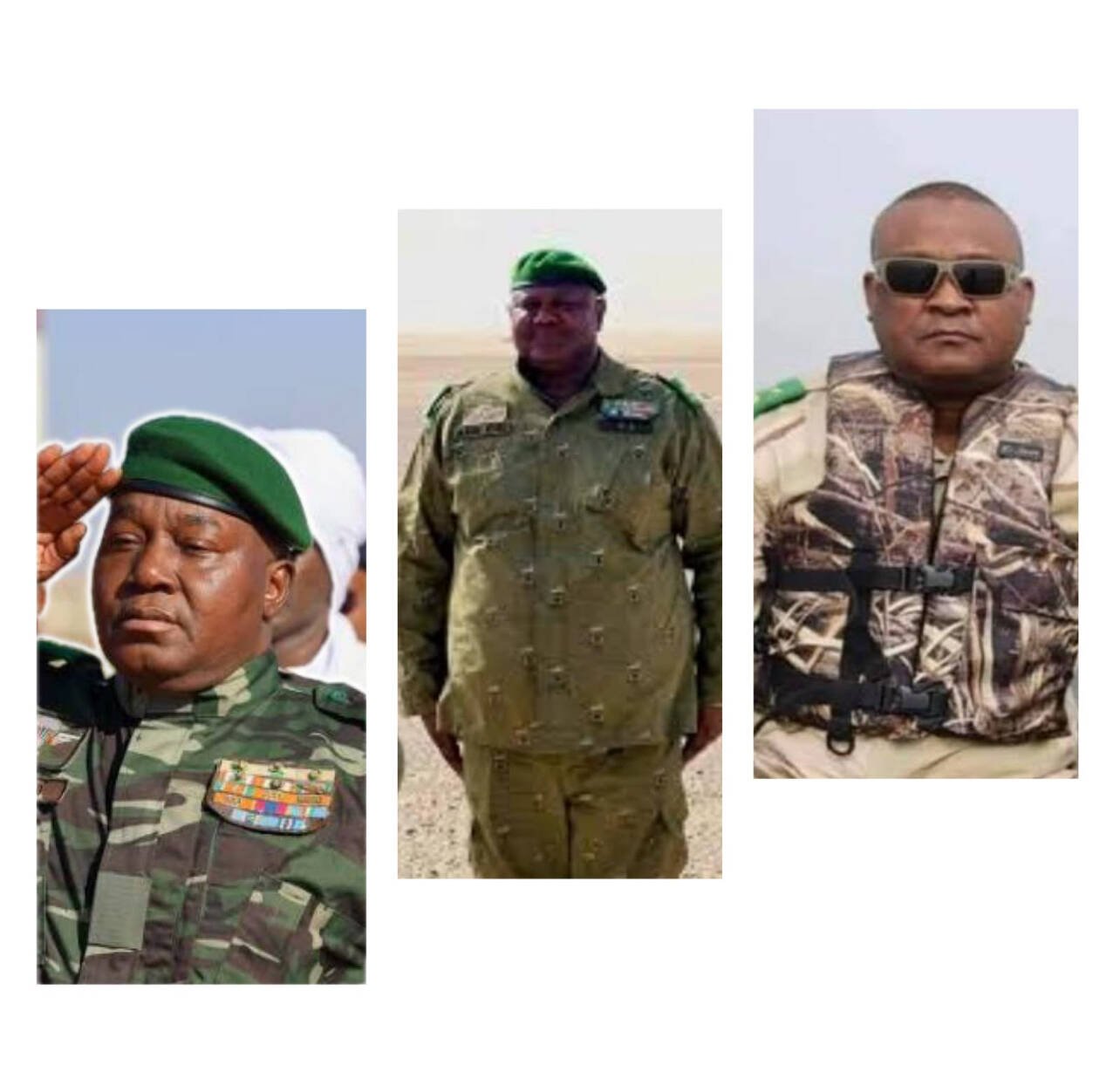
After Barmou: Is Niger shifting from a counter-terrorism army to a regime-protection force?
By: Zagazola Makama
The removal of Gen. Moussa Salaou Barmou as Chief of Staff of the Nigerien Armed Forces marks far more than a routine change at the top of the military hierarchy.
It may represent the opening phase of a deeper restructuring of Niger’s armed forces following the reported military mutiny of late August a restructuring driven not only by operational requirements, but increasingly by the ruling authorities’ overriding concern: loyalty to the regime.
On Friday, Sept. 11, Niger’s authorities announced the appointment of Brig. Gen. Mamane Sani Kiaou, previously Chief of Staff of the Army, as the new Chief of Staff of the Armed Forces, replacing Barmou.
The appointment came only days after reports of a serious internal military crisis that exposed divisions within the security establishment and raised questions about the confidence of Gen. Abdourahamane Tiani’s government in elements of its own armed forces.
The timing is significant. From elite commander to casualty of a military fracture Barmou was not an ordinary military officer.
Long before the July 2023 coup, he was one of the principal figures in the development of Niger’s special operations capabilities. He had commanded special forces formations and was closely associated with the Special Operations Command and Special Intervention Battalions.
He was also regarded as an experienced operational commander with extensive exposure to Western military training and international security cooperation. That background makes his removal particularly significant.
The very units and operational structures that Barmou helped build were designed to do one thing: find the enemy, move rapidly, strike hard and sustain pressure against armed groups operating across Niger’s vast and difficult terrain.
Today, however, some of those same capabilities appear to have become a source of political anxiety for the authorities. The question confronting the regime is no longer simply whether the army can defeat the Islamic State Sahel Province or Jama’at Nusrat al-Islam wal-Muslimin (JNIM). It is whether the most capable elements of the army can also be trusted not to challenge the government. That distinction could fundamentally reshape Niger’s military doctrine.
The reported military disturbances of Aug. 28 and 29 appear to have exposed a fracture that had been building beneath the surface. The crisis reportedly involved officers and personnel associated with highly trained operational formations precisely the kind of forces that any government fighting a determined insurgency would normally want to strengthen.
But for a regime that has already come to power through a military takeover, an armed force capable of independent action presents a different calculation. A professional military needs initiative. A regime worried about another coup needs control. That is the dilemma now confronting Niamey.
If the authorities conclude that highly trained and autonomous combat formations can become politically dangerous, they may begin prioritising loyalty over operational independence. That could mean targeted removals, transfers, command changes, closer surveillance of senior officers and a restructuring of special operations formations.
It could also mean strengthening formations considered politically more dependable, particularly those directly responsible for protecting the leadership. The circumstances surrounding Barmou’s departure are particularly important. According to information contained in the original analysis, Barmou was reportedly involved in attempts to manage the military crisis without escalating it into a confrontation between Nigerien soldiers.
He was said to have favoured negotiations with mutinous personnel, while other elements of the leadership reportedly considered a more forceful response, including Russian assistance.
Whether every element of that account is ultimately confirmed remains to be seen. But the broader political message is already clear.
Barmou’s removal suggests that the authorities are no longer comfortable leaving the management of sensitive military crises entirely in the hands of commanders whose primary instinct may be to preserve institutional cohesion. For a professional army, avoiding a fight between soldiers is often a virtue.
For a regime facing an internal military challenge, however, negotiation can be interpreted as weakness, hesitation or insufficient loyalty. That is where the relationship between operational professionalism and political reliability becomes dangerous.
Who is Mamane Sani Kiaou?
Kiaou enters the position at a particularly difficult moment. Before his promotion, he had reportedly toured several defence areas, including Agadez and Zinder, with official messaging focused on cohesion, engagement with troops, countering misinformation and lessons from the August crisis. His elevation therefore appears to have a significance beyond ordinary military rotation. He could be tasked with restoring discipline and operational effectiveness. But he may also be expected to restore political control over the military establishment.
If that becomes the dominant mission, the restructuring could extend deep into the special forces, command structures and elite formations. The immediate priority could be to ensure that no military formation becomes sufficiently autonomous, influential or powerful to pose a challenge to the political leadership.
This is where the greatest strategic danger lies.
Special forces are valuable because they possess initiative, cohesion, mobility, specialist training and the ability to operate with considerable independence. Those characteristics make them highly effective against insurgents. But those same characteristics can become politically uncomfortable for governments that fear military intervention. The temptation, therefore, is to dilute those capabilities.
Commanders can be rotated. Units can be reorganised. Senior officers can be transferred.
Special operations structures can be placed under tighter political supervision. Elite formations can be dispersed or absorbed into larger structures. And officers considered too influential or insufficiently reliable can gradually be removed from positions of authority.
Such measures may reduce the immediate coup risk. But they can also reduce battlefield effectiveness. An elite military capability that took years to build cannot simply be recreated by presidential decree. Training, institutional memory, battlefield experience, trust between commanders and soldiers, and the ability to operate independently under pressure are accumulated over years. Destroying that architecture is considerably easier than rebuilding it.
The jihadists may benefit from the distraction
This is the strategic paradox facing Niger.
While Niamey concentrates on controlling its military, JNIM and Islamic State militants remain focused on expanding their operational space.
The areas of Tillabéri, Tahoua and Diffa, together with Niger’s wider borderlands and the Liptako-Gourma region, require highly mobile, experienced and locally knowledgeable forces.
If elite formations become preoccupied with internal investigations, loyalty assessments, command changes and political surveillance, the insurgents may exploit the resulting gaps.
A commander worried about whether his decisions will later be interpreted as political disloyalty may become less willing to take operational risks. An officer concerned that influence over his troops could make him politically suspicious may avoid building strong independent command relationships. A military organisation obsessed with internal loyalty can gradually become less willing to exercise the initiative required in counter-insurgency warfare.
That is how a political security strategy can unintentionally produce an operational security problem.
Implications for Nigeria
If Niger’s elite combat units are weakened or distracted by internal restructuring, JNIM and Islamic State elements could exploit the security gaps along the Niger–Nigeria border. Instability in Niger could push terrorists, weapons and fighters toward Nigeria, particularly through vulnerable areas of Sokoto, Kebbi, Zamfara, Katsina, Jigawa and Yobe. Any deterioration in Niger’s military effectiveness could force Nigeria to deploy more resources to its northern borders and intensify surveillance and counter-terrorism operations. Increased Russian involvement in Niger could alter the regional security balance and potentially complicate intelligence-sharing and military cooperation between Niger and Nigeria. A politically preoccupied Nigerien military may have less capacity for effective cooperation with Nigeria and other regional partners against JNIM, Islamic State and cross-border criminal networks. lastly, Bandits, arms traffickers and terrorist groups could exploit any security vacuum along the largely porous Nigeria–Niger frontier.
The biggest concern for Nigeria is that a military focused increasingly on regime security rather than battlefield effectiveness could create a security vacuum on its doorstep. Any prolonged weakening of Niger’s counter-terrorism capacity would inevitably increase pressure on Nigeria’s already stretched northern security architecture.
Russia and the growing role of Africa Corps
Another dimension is Niger’s increasing reliance on Russian security support, particularly Africa Corps. Russian personnel can provide specialised capabilities, protect strategic installations and support selected operations.
But they cannot replace the Nigerien military.
Niger is a vast country of more than one million square kilometres, with difficult terrain, porous borders and insurgent networks that exploit local knowledge, mobility and community relationships. No foreign force can substitute indefinitely for a national military capable of operating across that entire environment.
The danger is therefore the emergence of a two-tier security system: heavily protected political and strategic centres around Niamey, while remote communities remain dependent on increasingly stretched national forces.
If the most capable Nigerien formations are simultaneously being reorganised for political reasons, the resulting gap could become even more significant.
The future position of Defence Minister Salifou Mody will also be important. Questions surrounding a possible reconfiguration of the military leadership have already generated speculation about whether Mody could eventually be moved to another political position while Tiani assumes greater direct control over defence affairs. There has also been speculation about Gen. Amadou Ibro, Tiani’s chief of staff, potentially receiving expanded responsibilities. These scenarios remain unconfirmed. But if subsequent decrees produce further changes at the top of Niger’s security architecture, Barmou’s removal will likely be remembered not as an isolated personnel decision but as the first visible step in a much wider restructuring.
The real test for Kiaou
The defining question for Mamane Sani Kiaou will therefore not simply be whether he can restore discipline. It will be what kind of discipline he is being asked to restore. If the objective is to rebuild cohesion, strengthen command structures, protect professional competence and ensure that the army remains focused on defeating insurgent groups, the restructuring could ultimately strengthen the Nigerien Armed Forces. But if the central objective is to ensure that the army can never again become a threat to the regime, the consequences could be very different.
The distinction is fundamental. An army built primarily around political loyalty looks toward the capital and asks: An army built primarily around national defence looks toward the battlefield and asks. The danger for Niger is that the two missions could gradually become confused.
Before the 2023 coup, the country invested heavily in building specialised forces capable of intelligence gathering, rapid deployment and counter-terrorism operations. The post-coup authorities inherited that architecture.
But the August 2026 crisis appears to have changed the political calculus. The men best trained to fight insurgents may now also be viewed as the men most capable of challenging the regime. That creates an uncomfortable choice.
The coming months will reveal which path Niamey chooses. If the restructuring preserves professional competence while restoring discipline and institutional cohesion, Niger could emerge with a more unified military.
If, however, loyalty tests, purges and political control become more important than battlefield effectiveness, the country could enter a dangerous cycle in which the military spends more time watching itself than watching the enemy. And that is precisely the opportunity insurgent groups do not need to be told about.