
Over 1,106 Boko Haram, ISWAP terrorists neutralised under outgoing Theatre Commander Abdulsalam
By Zagazola Makama
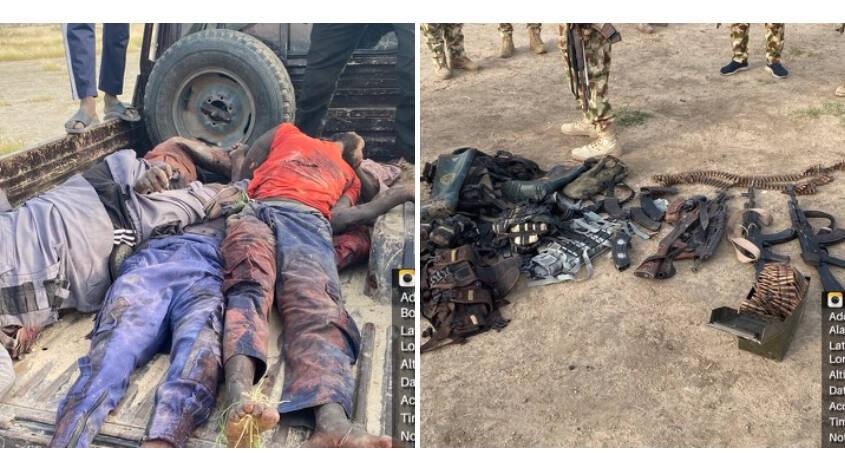
The outgoing Theatre Commander, Joint Task Force North East, Operation HADIN KAI (OPHK), Maj.-Gen. Abdulsalam Abubakar, says troops neutralised more than 1,106 Boko Haram and ISWAP terrorists during his tenure, including several high-profile commanders operating across the North-East.
Abubakar disclosed this during his farewell and introduction engagement with humanitarian partners, representatives of the Borno State Government and members of the press in Maiduguri.
The outgoing commander, who served as the 15th Theatre Commander of OPHK, said the operational successes were recorded through sustained kinetic and non-kinetic operations aimed at degrading terrorist networks and facilitating the restoration of normal socio-economic activities across the region.
He said among the notable terrorist leaders neutralised by troops were Abu Bilal Al-Muniki, also known as Abu Mainok; Malam Jidda, Amir of Ngorgore and Malumti villages; Abu Modu; Modu Dogo; Munzir of Dogon Chukun; Abu Aisha, Qaid of Tumbun Mota; and Abul Kaka, among others.
According to him, the elimination of the terrorist commanders and their fighters significantly disrupted elements of the Boko Haram and ISWAP networks and contributed to sustained pressure on the insurgents across the Theatre of Operations.
“The mandate given to Operation HADIN KAI when I assumed command was clear: to facilitate the restoration of normalcy in the North East so that socio-economic activities can thrive,” Abubakar said.
He explained that the military’s understanding of normalcy went beyond battlefield successes, noting that it was reflected in the restoration of essential services, reopening of markets and schools, resumption of farming activities and the return of displaced families to their ancestral communities.
Abubakar said the Theatre’s operations also resulted in the recovery of more than 475 assorted weapons and 24,409 rounds of ammunition of various calibres.
He added that troops discovered and safely detonated no fewer than 295 improvised explosive devices (IEDs) between April 2025 and September 2026, preventing the explosives from being used against troops and civilians.
The outgoing Theatre Commander said security forces also intensified operations against the financial and logistics networks sustaining terrorism in the region.
According to him, more than ₦300 million linked to terrorist financiers was intercepted, while at least 758 suspected terrorist logistics collaborators were arrested during the period.
He said the combination of sustained military offensives and non-kinetic engagements had further weakened terrorist formations, resulting in an unprecedented wave of surrenders.
Abubakar said over 969 JAS/ISWAP fighters and their family members surrendered within the last one year, attributing the development to sustained kinetic pressure and efforts to provide those willing to abandon terrorism with a dignified pathway out of the conflict.
The commander said the Theatre also rescued 638 civilians from terrorist enclaves, while troops successfully rescued all 46 students during an attempted abduction at the Federal Government Girls College, Monguno.
He noted that the operational gains had translated into broader improvements in security and the gradual restoration of civilian life in communities previously devastated by the insurgency.
According to him, more than 7,000 displaced families have returned to their ancestral communities, with returned communities now existing in every Local Government Area of Borno State.
He also highlighted the voluntary, safe and dignified repatriation of more than 3,000 Nigerian citizens from the Republic of Cameroon, carried out through collaboration between the Borno State Government, the Federal Ministry of Humanitarian Affairs and Poverty Reduction, and the United Nations High Commissioner for Refugees.
Abubakar described the exercise as a demonstration of what sustained cooperation among the military, government institutions and humanitarian partners could achieve in restoring stability to conflict-affected communities.
He said other indicators of improving normalcy included the return of the National Youth Service Corps orientation programme to Maiduguri after more than 13 years, while WAEC and NECO examinations are now being conducted in communities such as Banki and Gwoza.
Trade routes that were previously disrupted by the insurgency have also reopened, while local markets in several communities have resumed activities, he added.
The outgoing commander further said the Theatre was strengthened structurally and technologically during the period, including the operationalisation of Sector 4 to close an operational gap between Southern Borno and Northern Adamawa.
He said the induction of Nigerian Army Aviation helicopters and the Nigerian Army Remotely Piloted Aircraft System Regiment had enhanced the precision and effectiveness of air-supported operations.
According to him, the Military Command and Control Centre has also been strengthened to link frontline surveillance cameras, providing commanders with improved situational awareness and supporting quicker operational responses across the Theatre.
Abubakar said the achievements recorded during his tenure were products of collective efforts involving troops, other security agencies, the Borno State Government, humanitarian organisations, traditional and community leaders, the media and other stakeholders.
He urged the partners to sustain the cooperation and support necessary to consolidate the gains recorded in the fight against terrorism and the restoration of stability in the North-East.
Maj.-Gen. Abubakar is handing over the command of the North East Joint Task Force, Operation HADIN KAI, to Maj.-Gen. Ibikunle Ajose, who takes over as the new Theatre Commander.
The change of command comes as Operation HADIN KAI continues sustained operations against the remaining Boko Haram and ISWAP elements across the North-East, while supporting efforts to stabilise liberated communities and enable the continued return and resettlement of displaced populations.