Inside the Intelligence Web That Tracked Down ISWAP Commander Abu-Bilal al-Minuki
By: Zagazola Makama
For years, Abu-Bilal al-Minuki, a.k.a Abbor Mainok, moved like a shadow across West Africa’s insurgency landscape — an elusive, high-value commander whose name surfaced in fragmented intelligence reports, intercepted communications, and battlefield whispers across the Lake Chad Basin.
But what ultimately brought him into the crosshairs of a joint Nigeria–United States counterterrorism operation was not chance, nor a sudden intelligence windfall. It was the slow, patient tightening of an intelligence net, woven thread by thread by Nigerian security agencies and their international partners until escape became statistically impossible.
Security sources familiar with the operation describe the mission not as a single breakthrough, but as the end product of “months of layered intelligence convergence” involving the Department of State Services (DSS), the Nigerian Intelligence Agency (NIA), the Defence Intelligence Agency (DIA), and the United States Africa Command (AFRICOM).
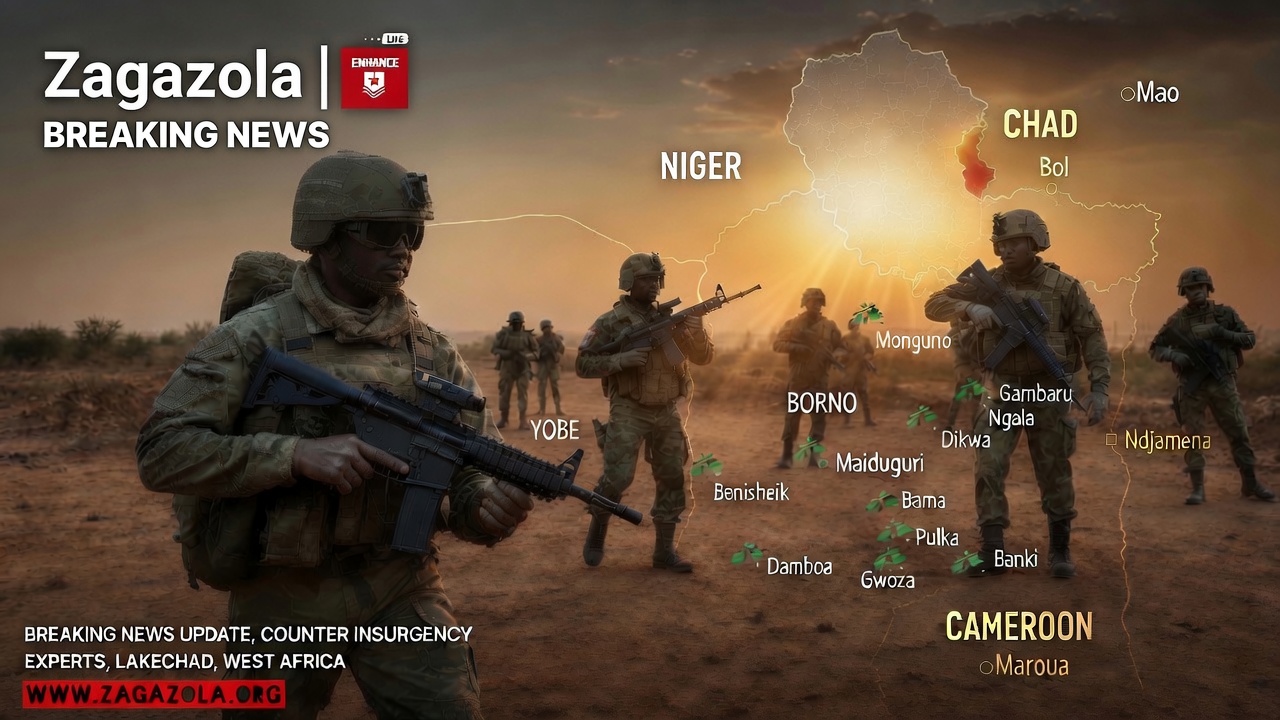
At the centre of this architecture was a quiet but persistent pursuit: mapping the movement, contacts, and behavioural patterns of a man described as “a mobile command node” within the Islamic State West Africa Province (ISWAP).
The intelligence trail reportedly began with intermittent sightings in Nigeria’s capital, Abuja an unusual pattern for a commander of his stature. Sources say al-Minuki was first flagged in Abuja during what appeared to be a low-profile civilian movement. He was later traced to Kano, where intelligence indicated he made contact with an ISWAP-linked facilitator from Yobe State.
From that point, the picture began to sharpen.
Each movement, once isolated, started forming a pattern: Kano to Yobe, Yobe to Maiduguri in March. The security intelligence agencies did not want to take him out prematurely. Later, from Maiduguri, he found his way deeper into the Lake Chad operational corridor.
It was here that Nigeria’s intelligence ecosystem began to operate less like separate agencies and more like a fused operational organism.
Human intelligence from local networks, surveillance inputs from theatre commands, and technical intercepts were no longer treated as independent streams. Instead, they were merged into a single analytical framework capable of tracking not just where al-Minuki was, but where he was likely to go next.
At a critical stage in March 2026, al-Minuki reportedly went off the radar. Rather than losing him, the system recalibrated.
Patterns of his known associates were re-examined. Communication networks were mapped with greater precision. Analysts built what one source described as a “predictive movement profile” a behavioural model that estimated not just his location, but his operational intent.Ten days before his elimination, it was gathered that he travelled to Iraq for an international engagement with the ISIS network. When he re-emerged, intelligence coverage resumed seamlessly.
A major turning point, according to intelligence sources, came with the arrest of a suspected ISWAP operational figure identified as Abdulrahman Ozovieh Muhammad, also known as Abu Ghozi. His detention, though initially treated as a separate internal security success, reportedly yielded a cascade of exploitable intelligence: contact lists, communication patterns, logistical arrangements, and possible operational linkages extending into the Lake Chad axis.
In intelligence terms, such captures often function as “access nodes” points through which larger networks become visible. It was through this expanding web that analysts believe critical confirmation of al-Minuki’s movements was achieved in the days leading up to the final operation.
By mid-May 2026, the intelligence picture had matured into a “validated target cycle.”
At this stage, Nigerian intelligence agencies were no longer merely supporting an operation they were co-owning it. AFRICOM’s surveillance and strike capabilities were integrated into a joint framework in which target confirmation, timing, and execution planning became shared responsibilities.
According to defence sources, this fusion was critical. Nigerian agencies provided the granular human intelligence and contextual mapping, while U.S. assets contributed advanced surveillance and precision strike capabilities. The result was a synchronized operational chain that left minimal room for error or escape.
When the strike eventually occurred in Metele, Borno State, it was described by officials as “precise, deliberate, and intelligence-validated.”
But before the strike, the joint team was determined to capture him alive. Troops were air-dropped at Ali Jamlari, very close to Metele.
The troops moved immediately and engaged the terrorists in heavy gunfire that lasted several hours. It was while al-Minuki was trying to escape that he was neutralized, while a few of his men escaped through Dogon Chukwu.
Early assessments indicated the elimination of al-Minuki alongside senior fighters, marking one of the most significant degradations of ISWAP’s command structure in recent years.
But beyond the immediate battlefield impact, the operation represented the maturity of Nigeria’s intelligence-led warfare doctrine. The success against al-Minuki illustrates a broader transformation in Nigeria’s counterterrorism strategy from reactive engagement to predictive disruption.
Rather than waiting for attacks or battlefield encounters, intelligence agencies are increasingly shaping the operational environment itself tracking leadership movements, pre-empting coordination, and dismantling networks before they fully activate.
Last year, two most-wanted terrorist kingpins, Abu Baraa and Mahmuda, were captured through the diligent and coordinated work of Nigeria’s Department of State Services (DSS).
The psychological impact, too, is becoming visible.
This year alone, the Nigerian Army under Operation HADIN KAI has eliminated more than 57 ISWAP commanders in major leadership decapitation operations. Reports from the theatre already suggest growing anxiety among insurgent fighters, increased fragmentation of units, and a decline in operational cohesion signs that sustained intelligence pressure, combined with ground and air offensives, is achieving effects beyond physical attrition.
While the strike itself will dominate headlines, security insiders insist the real story lies in what cannot be seen: the coordination rooms, the analytical boards, the intercepted signals, the human sources operating in silence, and the inter-agency trust that allowed intelligence to flow without friction.
In that hidden architecture, they say, lies the true victory. In that sense, the true achievement lies not only in the elimination of a high-value target, but in the demonstration that coordinated intelligence when sustained, disciplined, and shared across institutions and borders can reshape the trajectory of asymmetric conflict.
Zagazola Makama is a Counter-Insurgency Expert and Security Analyst in the Lake Chad Region.