Senegal Faces Institutional Test Amid Growing Leadership Rivalry
By: Zagazola Makama
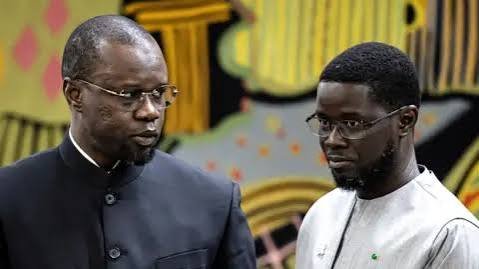
Senegal appears to be entering a delicate political phase as tensions between President Bassirou Diomaye Faye and his longtime political mentor, Ousmane Sonko, continue to reshape the country’s power dynamics and raise fresh concerns about the future of its democratic institutions.
What initially appeared to be a smooth transfer of influence within the ruling PASTEF movement is increasingly looking like a struggle over authority, legitimacy and political control at the highest levels of the state.
At the centre of the unfolding political debate is Ousmane Sonko, former Prime Minister and founder of the PASTEF party, who recently emerged as President of Senegal’s National Assembly after his exit from government. Despite leaving the executive branch, Sonko’s influence within the ruling coalition remains significant, reinforcing the perception that he continues to shape major political decisions from outside the presidency.
The situation has inevitably drawn comparisons to the famous phrase associated with former French President Charles de Gaulle — “Me or chaos” — reflecting fears among some observers that Senegal may gradually drift toward a political system where individuals overshadow institutions.
For decades, Senegal distinguished itself within West Africa through relatively stable republican traditions, strong institutional continuity and peaceful political transitions. However, the growing concentration of influence around personalities rather than state institutions now risks testing that legacy.
The transition from opposition activism to state governance has also exposed contradictions within the ruling coalition. What once united PASTEF against former President Macky Sall is now revealing internal tensions over power-sharing, political direction and leadership ambitions.
The increasingly visible rivalry between Sonko and Diomaye Faye signals broader uncertainties about the balance of power within Senegal’s post-2024 political order.
One of the most controversial moments in recent days was Sonko’s reported reception at the National Assembly to the sound of Tala‘a al-Badru ‘Alayna, the historic Islamic chant associated with the of Prophet Muhammad (PBUH) following the Hijrah to Medina.
While supporters may have intended the gesture as symbolic admiration, its use in a political setting has triggered criticism from those who believe sacred religious references should remain separate from political glorification.
In a deeply religious society like Senegal, the fusion of political mobilisation and sacred symbolism carries serious implications. Excessive elevation of political figures through spiritual imagery can encourage personality cults and weaken the secular foundations upon which republican governance rests.
The fallout between Diomaye and Sonko appears to have deepened further after Sonko’s removal from government. If the presidency believed sidelining him would reduce his political leverage, recent developments suggest the opposite may have occurred.
By taking control of the National Assembly, Sonko now occupies a strategic institutional position that allows him to remain at the centre of national politics while simultaneously operating as an independent political force capable of directly challenging the presidency.
As a result, the relationship between both men has become the defining issue in Senegalese politics. Whether cooperation or confrontation prevails may ultimately determine the stability of the ruling coalition and the direction of governance in the coming years.
Another emerging dimension of the debate is the reassessment of former President Macky Sall’s legacy.
Many Senegalese who strongly opposed Sall’s administration are beginning to reconsider aspects of his leadership amid frustrations over political disorder, elite rivalries and governance uncertainties under the current administration.
Macky Sall governed during periods of intense political confrontation, yet state institutions largely retained continuity and coherence throughout his presidency. Today, some citizens increasingly view that period as comparatively stable and structured.
This does not necessarily erase criticisms previously directed at his government, but it reflects a broader political reality often seen during transitions: public expectations for rapid change are not always matched by governing realities.
The current political atmosphere has also revived debate about populism and democratic fragility in Senegal.
The anti-establishment rhetoric, emotional mobilisation and street politics that powered the opposition movement against Macky Sall proved highly effective electorally. However, governing a state requires institutional discipline, strategic coherence and consensus-building — challenges that now appear to be testing the ruling establishment.
What is increasingly evident is that defeating an incumbent government is often easier than managing the complexities of state power afterward.
The growing tensions within Senegal’s leadership circle have therefore become more than a personal rivalry. They now reflect broader questions about governance, institutional resilience and the future character of Senegalese democracy.
At stake is whether institutions will remain stronger than individuals, or whether political competition will gradually erode the republican culture that long distinguished Senegal within the region.
The coming months may prove decisive not only for the future of the Diomaye-Sonko partnership, but also for the long-term stability and democratic trajectory of Senegal itself.