Seven Years After: How Buni’s Security Reforms Helped Rebuild Confidence in Yobe
By: Zagazola Makama
Seven years after assuming office as Governor of Yobe State, Hon. (Dr.) Mai Mala Buni’s administration is increasingly being defined by one central theme, the restoration of peace, stability and public confidence in a state once heavily battered by insurgency and humanitarian crises.
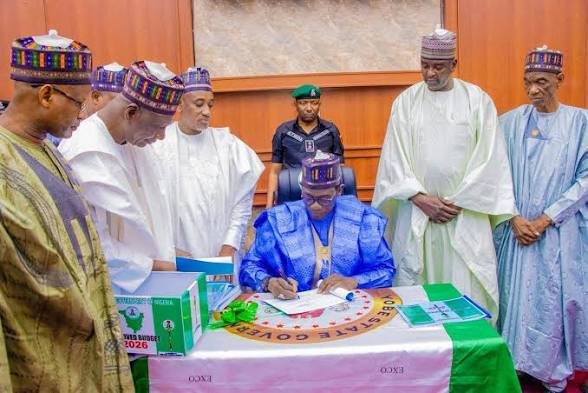
At a press conference held on Friday in Damaturu to commemorate the seventh anniversary of the administration, the Acting Secretary to the State Government, Dr. Mohammed Goje, described the period as a journey of “continuity, consolidation, recovery and transformation.”
Beyond the ceremonial speeches and anniversary reflections, the event offered a broader insight into how Yobe State has gradually repositioned itself from a frontline theatre of insecurity into one of the more stable states in North-East Nigeria.
For many residents, the significance of this transformation lies not merely in statistics or infrastructure projects, but in the return of normal life across communities that once lived under the constant shadow of fear and uncertainty.
When Governor Buni assumed office in 2019, Yobe, like much of the North-East, was still grappling with the consequences of years of insurgency. Entire communities had been displaced, economic activities disrupted, schools shut down and public infrastructure severely weakened.
Security, therefore, became the foundation upon which the administration built its broader development agenda.
According to Dr. Goje, the government adopted a comprehensive strategy that combined operational support for security agencies with community engagement, peacebuilding initiatives and humanitarian recovery programmes.
Over the past seven years, the administration procured and deployed more than 200 operational motorcycles and 60 patrol vehicles to strengthen the operational capacity of the military, police, vigilante groups, hunters and community response structures operating across the state.
The government also rehabilitated the 233 Battalion Barracks, constructed accommodation facilities for military personnel, developed access roads within military formations and facilitated the establishment of a military camp in Gashua.
Security agencies, including the Nigerian Armed Forces, Police, Department of State Services (DSS), Nigeria Security and Civil Defence Corps (NSCDC), NDLEA and the Correctional Service, also received sustained logistical support ranging from operational mobility to fuel supply, equipment maintenance and medical assistance.
Beyond direct operational support, the administration sought to strengthen institutional coordination and intelligence sharing through the establishment of the Yobe State Security Stakeholders Forum.
The forum, according to officials, created a platform for collaboration among security institutions, traditional rulers, community leaders and government officials in addressing evolving security threats.
In addition, more than 100 government officials underwent specialised training in areas such as criminal intelligence, crisis management, strategic anticipation and non-kinetic security operations through institutions including the Defence Intelligence College and the National Institute for Policy and Strategic Studies (NIPSS).
One of the less visible but important aspects of the administration’s security approach has been its emphasis on welfare and morale among security personnel.
The government provided financial assistance to wounded officers and families of fallen personnel, constructed accommodation for senior officers and allocated land for the Armed Forces Casualty Trust Fund housing scheme for deceased and incapacitated personnel.
Such interventions contributed not only to operational effectiveness but also to strengthening trust between the state government and security institutions operating within Yobe. The impact of these measures is increasingly visible across many parts of the state.
Roads once considered unsafe are now witnessing increased commercial activity. Markets have reopened and expanded. Schools that were previously shut due to insecurity are functioning again, while farming and transportation activities have resumed in several communities.
Communities previously displaced by violence are gradually rebuilding social and economic life, supported by relative stability and renewed confidence in public institutions.
Residents in Damaturu, Gashua, Nguru and several local government areas now speak more openly about economic recovery, improved mobility and the return of social interactions that were once severely disrupted by insurgency.
While security challenges have not entirely disappeared from the wider North-East region, many believe Yobe’s experience demonstrates the importance of combining military support with governance reforms, community engagement and institutional resilience.
The administration’s broader development efforts in education, healthcare, infrastructure and economic empowerment have also benefited from the relatively improved security environment.
The anniversary of Buni administration serves not only as a political milestone but also as an attempt to present Yobe as a state moving steadily from recovery toward long-term stability and development.