Targeting Kwankwaso over Twitter exchange with U.S. lawmaker Riley Moore is witch-hunt
By: Zagazola Makama.
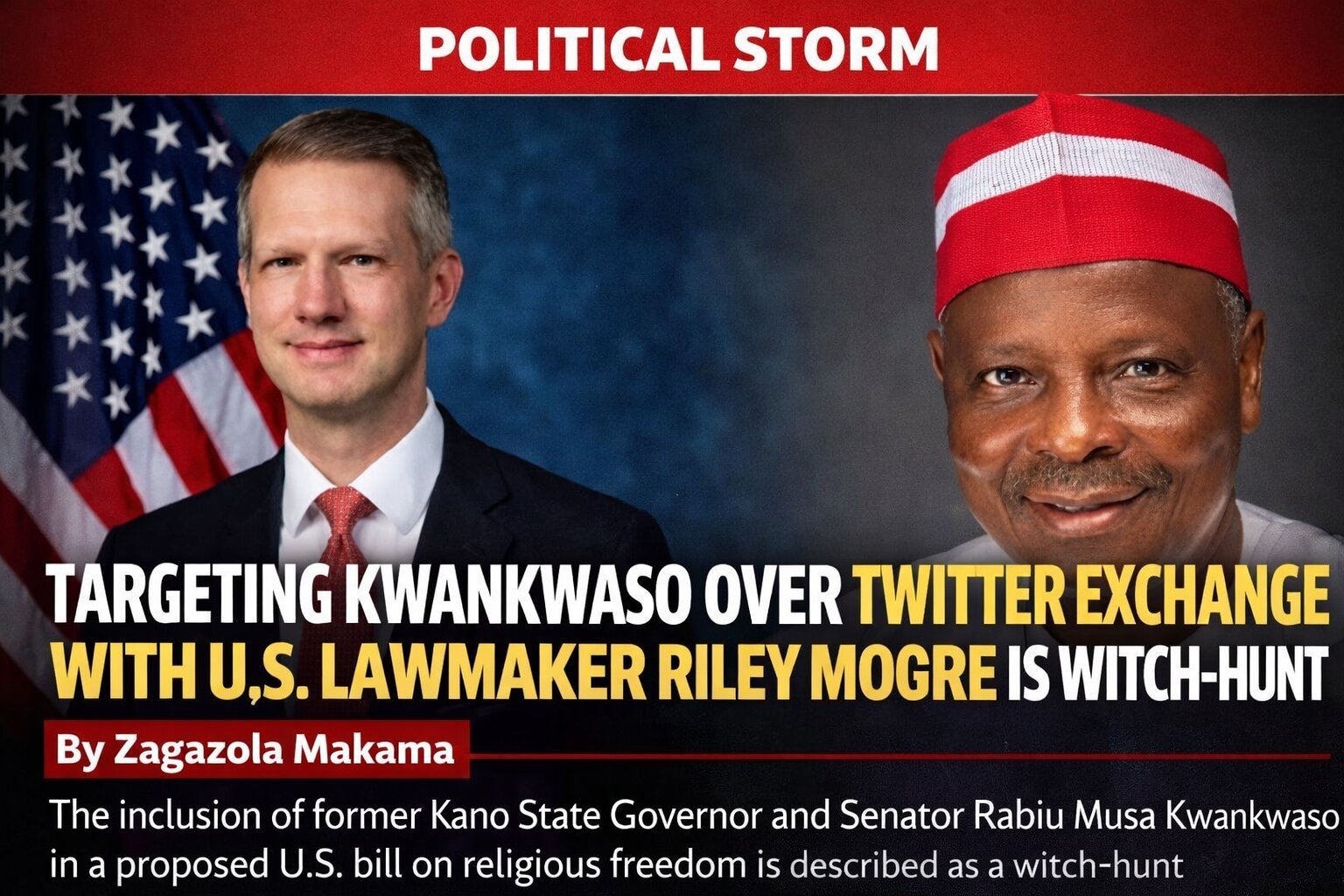
The inclusion of former Kano State Governor and Senator Rabiu Musa Kwankwaso in a proposed U.S. bill on religious freedom is nothing but a witch-hunt and grave injustice, as it is not based on any evidence but on a public disagreement with US Reps Riley Moore on X otherwise known as Twitter.
The proposed Nigeria Religious Freedom and Accountability Act of 2026, sponsored by U.S. Representatives Riley Moore and Chris Smith, seeks to sanction Fulani militias and Kwankwaso over alleged Christian persecution in Nigeria.
However, critics argue that Kwankwaso’s inclusion followed his Twitter (X) exchange with Rep. Moore, rather than any proven role in religious violations.
Naming Kwankwaso among those accused of supporting Christian persecution without a shred of evidence simply because he challenged Rep. Moore’s narrative online is witch-hunting and injustice.
The disagreement followed President Donald Trump’s recent designation of Nigeria as a “Country of Particular Concern” over alleged violations of religious freedom.
In response, Kwankwaso issued a statement expressing concern over what he described as “heightened pronouncements” on Nigeria by the U.S. President, warning that such rhetoric could deepen divisions rather than address the country’s real security challenges.
“I have noted with increasing concern the heightened pronouncements on Nigeria by President Donald Trump. This follows his designation of Nigeria as a ‘country of particular concern’,” Kwankwaso said.
He stressed that Nigeria was a sovereign nation facing threats from outlaw groups that did not discriminate based on religion, ethnicity or politics.
“These threats come from terrorist and criminal networks whose victims are both Muslims and Christians. What Nigeria needs is support in technology, intelligence and operational capacity, not threats that polarise our people,” he said.
Kwankwaso also urged unity among Nigerians and called on the Federal Government to strengthen diplomatic engagement with the United States through special envoys and permanent ambassadors.
“To my fellow countrymen, this is an important moment where we should emphasise unity of belonging over division. God bless Nigeria,” he added.
In a swift reaction on X (formerly Twitter), Rep. Moore accused Kwankwaso of hypocrisy and linked him to alleged religious persecution in Northern Nigeria.
“Governor, do you care to comment on your own complicity in the death of Christians? You instituted Sharia law. You signed the law that makes so-called blasphemy punishable by death,” Moore wrote.
The U.S. lawmaker’s post appeared to connect Kwankwaso’s role in implementing Sharia law in Kano State during his tenure as governor to ongoing concerns about religious freedom in Nigeria.
The U.S. lawmaker’s reaction shifted from policy debate to personal targeting. This is not accountability. It is retaliation for speaking back.
Linking Sharia law directly to what is happening today with Bandits, Boko Haram and ISWAP is misleading. Sharia law is part of Nigeria’s constitutional federal structure. It is not genocide. Terrorism is. The real killers of Christians, Muslims and other faithfuls alike are Boko Haram, ISWAP, bandits, JNIM and Lakurawa, not Kwankwaso.”
Based on records, Kano State, under Kwankwaso’s leadership, confronted Boko Haram cells and prevented the group from establishing a foothold in the state during the peak of the insurgency.
Kano was the only state in the North-West that averted bloodshed by decisively confronting the Boko Haram cells and brought their activities to a standstill. At a time when Boko Haram was expanding across northern Nigeria, Kano shut down their recruitment networks, dismantled logistics cells and prevented the sect from gaining territorial control. That record alone contradicts any claim that Kwankwaso enabled religious extremism.
Security Analyst, Bulama Bukarti, wrote “Truth be told, Kwankwaso is among the most moderate and pro-Nigeria politicians the country has ever produced. Naming him in the U.S. House bill as the sole individual to be sanctioned is not only unfair but plainly erroneous. His name should be withdrawn from the bill without delay.
“More broadly, this episode exposes the poor quality of the information underpinning the so-called “Christian genocide” narrative. Its proponents just generate and circulate unsubstantiated claims and then rely on those same claims as evidence,”he said.
As off now, no evidence has ever been presented linking Kwankwaso to acts of Christian persecution. Kano under Kwankwaso did not witness any attacks on Christians.
Therefore, using foreign legislation to punish political figures for online disagreements sets a dangerous precedent. If foreign lawmakers can label Nigerian politicians as persecutors simply because of Twitter arguments, then this is no longer about human rights, it is about political intimidation. Such actions undermine Nigeria’s sovereignty and fuel sectarian tension. Justice requires evidence. Not tweets. Not grudges. Not activism.