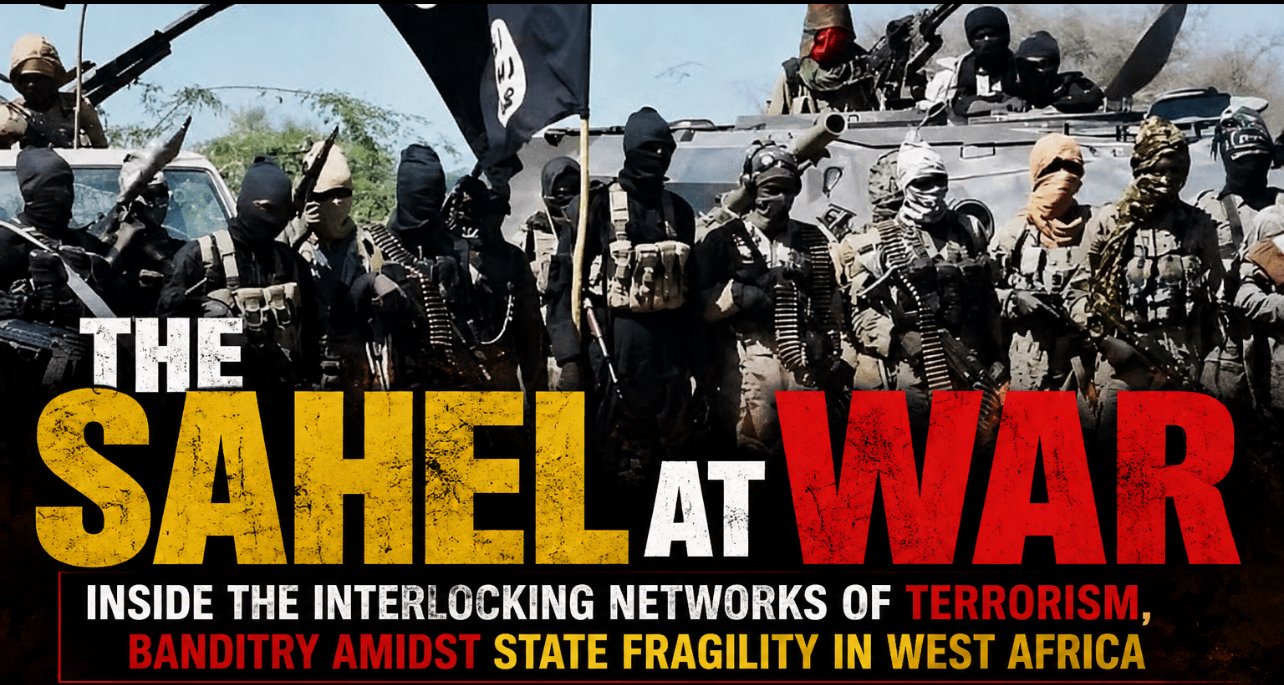
The Sahel at War: Inside the Interlocking Networks of Terrorism, Banditry Amidst State Fragility in West Africa
By Zagazola Makama
West Africa and the Central Sahel are no longer confronting isolated insurgencies. They are confronting the emergence of an integrated conflict ecosystem stretching from the shores of Lake Chad through the Sahelian heartland to the northern fringes of the Gulf of Guinea. The violence that once appeared compartmentalized Boko Haram in northeastern Nigeria, jihadists in northern Mali, criminal bandits in Zamfara, or communal clashes between farmers and pastoralists has evolved into a mutually reinforcing network of terrorism, organized crime, illicit finance, governance failure, and regional geopolitical competition.
Today’s conflict cannot be understood just by counting attacks or measuring how much land militants control. The real fight is happening in areas where the government is absent, where illegal businesses replace official systems, and where extremist groups are stepping in to provide security, justice, taxes, and economic opportunities more effectively than the state.
This evolution has transformed the security crisis from a collection of national emergencies into one of Africa’s most consequential strategic challenges.
The current conflict is driven by three distinct but increasingly interconnected actors: violent extremist organizations, criminal syndicates, and state or quasi-state military actors.
Each operates differently. Yet each increasingly influences the operational environment of the others.
The Jihadist Expansion
Among violent extremist organizations, Jama’at Nusrat al-Islam wal-Muslimin (JNIM) has emerged as arguably the most adaptive insurgent movement in the region. Unlike earlier extremist organizations whose campaigns depended primarily upon spectacular terrorist attacks, JNIM has steadily shifted toward governance-oriented insurgency. It exploits local grievances, negotiates with communities, arbitrates disputes, regulates commerce, and selectively employs violence to consolidate influence. Its operational success derives less from superior firepower than from political agility.
Where governments disappear, JNIM frequently arrives with its own version of administration.
This explains its steady expansion beyond Mali into Burkina Faso, Niger and increasingly toward the northern territories of Benin, Togo and, potentially, Ghana. Rather than conquering cities, JNIM captures strategic corridors transport routes, border crossings, grazing areas and commercial networks that gradually reshape political authority. Its principal competitor, the Islamic State Sahel Province (ISSP), formerly known as ISGS, pursues a markedly different strategy.
ISSP emphasizes uncompromising violence.
Its campaigns frequently involve mass killings, collective punishment and deliberate intimidation designed to destroy resistance rather than cultivate legitimacy. Competition between JNIM and ISSP has itself become one of the defining characteristics of Sahelian instability, with both organizations fighting each other almost as frequently as they confront state forces.
Meanwhile, farther east, the Lake Chad Basin remains dominated by the Islamic State West Africa Province (ISWAP) and the residual Boko Haram faction known as Jama’atu Ahlis Sunna Lidda’awati wal-Jihad (JAS). Unlike the fluid insurgencies of the western Sahel, ISWAP has developed an increasingly sophisticated quasi-state structure. Its taxation systems, logistical networks, intelligence apparatus and shadow governance enable it to maintain influence despite years of sustained military pressure by regional forces.
Criminality Without Ideology
Running parallel to the jihadist insurgencies is another formidable threat: organized armed banditry. Northwestern and North-central Nigeria have become the epicentre of highly militarized criminal networks whose objectives are economic rather than ideological.
These groups increasingly possess military-grade capabilities. Rocket-propelled grenades, anti-aircraft weapons mounted on technical vehicles, heavy machine guns and sophisticated communications equipment have transformed what once resembled rural criminal gangs into mobile armed organizations capable of overwhelming isolated security positions.
Kidnapping has evolved into an industrial enterprise. Unlike earlier phases of criminal abduction that focused primarily on expatriates or wealthy elites, today’s bandits conduct mass kidnappings involving schoolchildren, farming communities, religious institutions and entire villages. Ransom payments generate enormous revenue. That revenue fuels arms purchases, recruitment, logistics and territorial expansion.
Banditry has therefore become not merely a criminal phenomenon but a strategic destabilizing force with regional implications.
The greatest danger confronting West Africa lies not in any single organization but in the growing convergence between extremist violence and organized criminality. The relationship is best understood as a marketplace rather than an alliance. Bandits generate money. Extremists generate military expertise. Both benefit.
JNIM, for example, has increasingly exchanged tactical instruction, weapons handling and operational knowledge for logistical access, intelligence and freedom of movement provided by criminal groups. This arrangement does not require ideological alignment. It requires only mutual benefit. The distinction between terrorist financing and organized crime has therefore become progressively blurred. Weapons purchased with ransom proceeds frequently circulate across multiple armed actors. Traffickers move guns, ammunition, fuel, narcotics and gold using identical smuggling routes. The same criminal infrastructure serves jihadists, bandits and transnational organized crime simultaneously. The result is a conflict economy capable of sustaining violence indefinitely.
The Fulani Question: Identity, Marginalization and Manipulation
Perhaps no issue within the regional security debate has generated more misunderstanding than the relationship between Fulani pastoralists and armed violence. Reducing the crisis to ethnicity obscures its deeper structural foundations. The overwhelming majority of Fulani communities remain peaceful pastoralists. Yet prolonged environmental degradation, climate change, shrinking grazing corridors, cattle rustling, weak governance and chronic insecurity have created conditions under which segments of marginalized pastoral youth became progressively militarized. What began in many areas as localized self-defence groups gradually transformed into organized criminal formations.This evolution did not occur in isolation. It emerged within environments where state institutions failed to provide security, resolve disputes or regulate access to land and water. As farmer-herder conflicts intensified, collective punishment frequently replaced targeted law enforcement. Communities perceived to share ethnic identity with criminal actors increasingly became targets themselves.
It is within this environment that JNIM has demonstrated remarkable strategic sophistication. Rather than recruiting primarily through ideology, it recruits through protection.
When communities believe they are abandoned or worse, indiscriminately targeted extremist organizations present themselves as defenders.
Protection gradually becomes allegiance. Allegiance becomes recruitment. Recruitment becomes insurgency. The conflict therefore evolves from a dispute over grazing land into participation in transnational jihad. This cycle represents one of the most significant strategic challenges confronting governments throughout the Sahel. Military victories alone cannot dismantle recruitment systems built upon unresolved grievances.
Gold: The Conflict’s Hidden Currency
If kidnapping finances today’s bandits, artisanal gold increasingly finances tomorrow’s insurgencies. The discovery and rapid expansion of informal gold mining across Mali, Burkina Faso, Niger and parts of Nigeria fundamentally altered the economics of regional conflict. Extremist organizations rarely conduct mining themselves. Instead, they regulate it.
By controlling access to remote mining sites, imposing taxes on miners, charging transit fees and monopolizing protection, armed groups have established remarkably resilient revenue streams. Gold possesses advantages that narcotics and conventional financial transfers do not. It is anonymous. It is portable. It is difficult to trace. It retains value internationally.
Smuggled through regional trading hubs and international markets, illicit gold enters legitimate global supply chains with relative ease. Revenue subsequently returns to conflict zones as cash, fuel, vehicles and weapons.
Mining camps simultaneously function as recruitment centres, logistics hubs and operational sanctuaries. As long as these informal economies remain outside effective government regulation, they will continue to finance insurgency irrespective of battlefield outcomes.
A Fragmented Security Architecture
The security landscape has become further complicated by changing regional alliances.
The emergence of the Alliance of Sahel States (AES) comprising Mali, Burkina Faso and Niger has fundamentally altered West Africa’s collective security framework. The withdrawal of these states from ECOWAS and their shift toward closer security cooperation with Russian military elements have introduced new political realities into regional counterterrorism efforts.
Although the AES governments emphasize sovereign security strategies and aggressive military operations, political fragmentation has simultaneously weakened regional intelligence coordination. This fragmentation creates opportunities for extremist organizations.
Terrorist groups do not recognize political disagreements between governments. They exploit them. The absence of seamless intelligence sharing across borders enables armed groups to attack in one jurisdiction before relocating into another beyond immediate pursuit. No counterterrorism campaign can succeed while terrorists enjoy greater operational mobility than the states pursuing them.
Why Military Success Alone Is Not Enough
Military operations remain indispensable.
No government can negotiate away organizations committed to systematic violence against civilians. Yet experience across the Sahel demonstrates that battlefield victories alone rarely produce durable stability.
Territory may be retaken. Governance often is not. Where governments fail to restore justice, education, healthcare, infrastructure, markets and policing, insurgents frequently return. The vacuum persists. Only the actors occupying it change. Counterterrorism therefore requires simultaneous security, governance and economic interventions. Without this integration, tactical victories risk becoming temporary interruptions rather than strategic success.
Building an Integrated Regional Response
A sustainable security strategy requires far more than increased troop deployments. First, regional intelligence cooperation must be restored regardless of political disagreements.
Functional information-sharing mechanisms between the AES, ECOWAS and Lake Chad Basin states remain essential if cross-border insurgent mobility is to be disrupted. Second, governments must formalize the artisanal mining economy. Licensing miners, establishing transparent state purchasing systems and regulating mineral exports would significantly reduce extremist access to illicit gold revenues.
Third, pastoralist integration must become a security priority rather than solely an agricultural issue. Protected grazing corridors, modern livestock infrastructure, impartial dispute-resolution mechanisms and equal legal protection for farmers and herders are not simply development initiatives they are counterterrorism measures. Finally, security institutions must prioritize precision over collective punishment. Every indiscriminate operation risks creating tomorrow’s recruits.
Every community protected strengthens the legitimacy of the state. Counterinsurgency succeeds not when insurgents fear the government, but when civilians trust it more than they trust armed groups.
Conclusion: Winning the Governance War
The future of West Africa’s security will not be determined solely on battlefields. It will be determined in villages where governments either return or fail to return. The central contest is no longer simply between states and terrorists.
It is between competing systems of governance.
Violent extremist organizations understand this reality. Their objective is not merely to kill soldiers but to replace governments. Military operations can destroy camps. They cannot, by themselves, replace institutions. The challenge confronting West Africa and the Central Sahel is therefore not only defeating insurgencies, dismantling criminal economies or securing borders. It is rebuilding the legitimacy of the state itself. Until governance fills the vacuum now occupied by violence, instability will continue to migrate across borders, adapt to new pressures and regenerate in new forms.
The battle for the Sahel is ultimately a battle over political authority, economic opportunity and public trust. Whoever succeeds in providing those three elements will shape the future security architecture of West Africa for decades to come.
Zagazola Makama is a Counter Insurgency Expert and Security Analyst in the Lake Chad Region