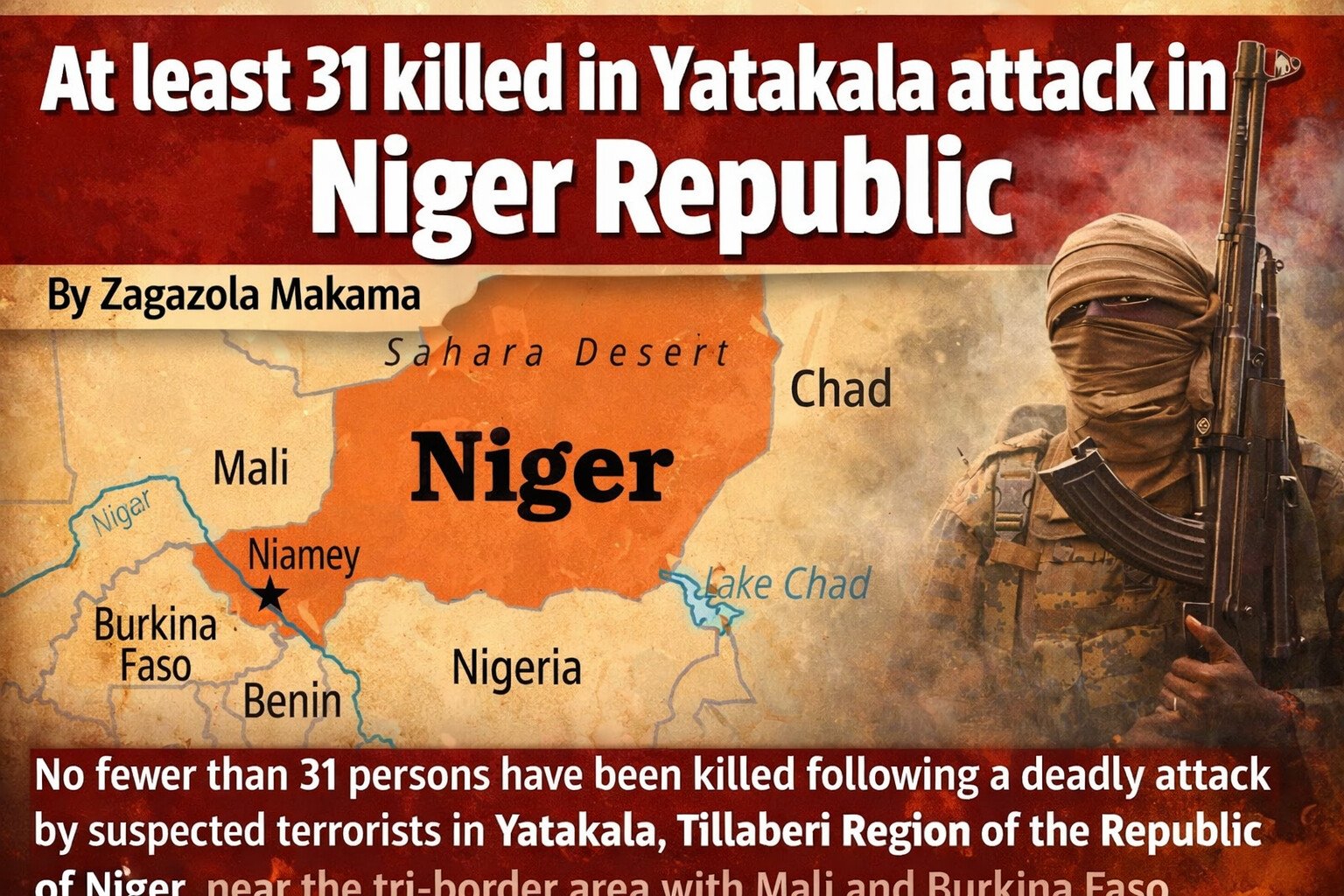
At least 31 killed in Yatakala attack in Niger Republic
By: Zagazola Makama
No fewer than 31 persons have been killed following a deadly attack by suspected terrorists in Yatakala, Tillaberi Region of the Republic of Niger, near the tri-border area with Mali and Burkina Faso.
Sources told Zagazola Makama that the attack occurred on Jan. 18 in the Yatakala/Bolsi area of Tera Commune, where the assailants reportedly gathered residents together and opened fire on them.
The sources said that several other people, believed to be mostly women, were abducted during the attack, while five persons were injured as they tried to escape.
“They went from house to house, rounded people up and shot them. Those who managed to flee sustained injuries.
“Residents were rounded up and summarily executed, while an uncertain number mostly women, were abducted. At least 31 people were killed and five others injured as they fled,”one of the sources said.
The sources noted that Yatakala and surrounding villages toward the Burkinabe border had already been deserted by many inhabitants due to persistent attacks by armed groups.
No organisation had formally claimed responsibility for the latest atrocity, but the pattern and area of operation point strongly to Jama’at Nusrat al-Islam wal-Muslimin (JNIM), the Al-Qaeda-linked group active across the Liptako-Gourma axis
The area had previously come under attack on Jan. 3, 2026, when Yatakala/Garoul was assaulted and about 17 soldiers were reportedly killed.
Zagazola report that the Tillaberi theatre is under sustained pressure. The enemy appears intent on clearing large swathes of territory, forcing communities to abandon their homes and creating humanitarian corridors of displacement that terrorists then exploit for further expansion.
The attacks also draws to the attention of the accelerating expansion of jihadist violence across the Sahel and its dangerous spillover implications for Nigeria and the wider West African sub-region.
The attack fits into a broader campaign by both Al-Qaeda- and ISIS-aligned factions to dominate borderlands, forest reserves and riverine routes, particularly around the W Park–Panjari complex, with a creeping approach toward Niamey.
The strategic objective was to degrade state presence, terrorise civilians into flight, and establish uncontested movement and recruitment zones.
Its draws parallels with past atrocities, including the January 2025 killings in Kasuwan Daji in Borgu area of Niger State, allegedly carried out by JNIM in collaboration with JAS/Ansaru networks, as well as recent mass abductions at worship centres in Kurmin Wali, Kajuru LGA, Kaduna State.
These are not isolated incidents. They form part of a synchronised regional campaign aimed at destabilisation, psychological dominance and narrative warfare.
Zagazola warned that beyond the kinetic dimension, insurgents were also leveraging disinformation, including the manipulation of religious and ethnic narratives, to internationalise their cause and weaken regional cohesion.
The humanitarian crisis generated by these attacks will push refugees and internally displaced persons toward north-west and north-central Nigeria, with attendant security, social and economic consequences.
Therefore, Nigeria’s response must go beyond internal counter-terrorism operations to include strengthened diplomatic and security cooperation with Niger, Benin and other frontline states.
Border challenges cannot be curbed unilaterally. There must be deeper intelligence sharing, coordinated patrols and joint operations. ECOWAS and the Alliance of Sahel States (AES) must urgently re-engage on collective security mechanisms to contain this expanding threat,” he said.
Yatakala massacre was both a warning and a call to action.
If proactive regional measures are not taken, the Sahelian conflict arc will continue to bend southward, with Nigeria increasingly in the line of fire.