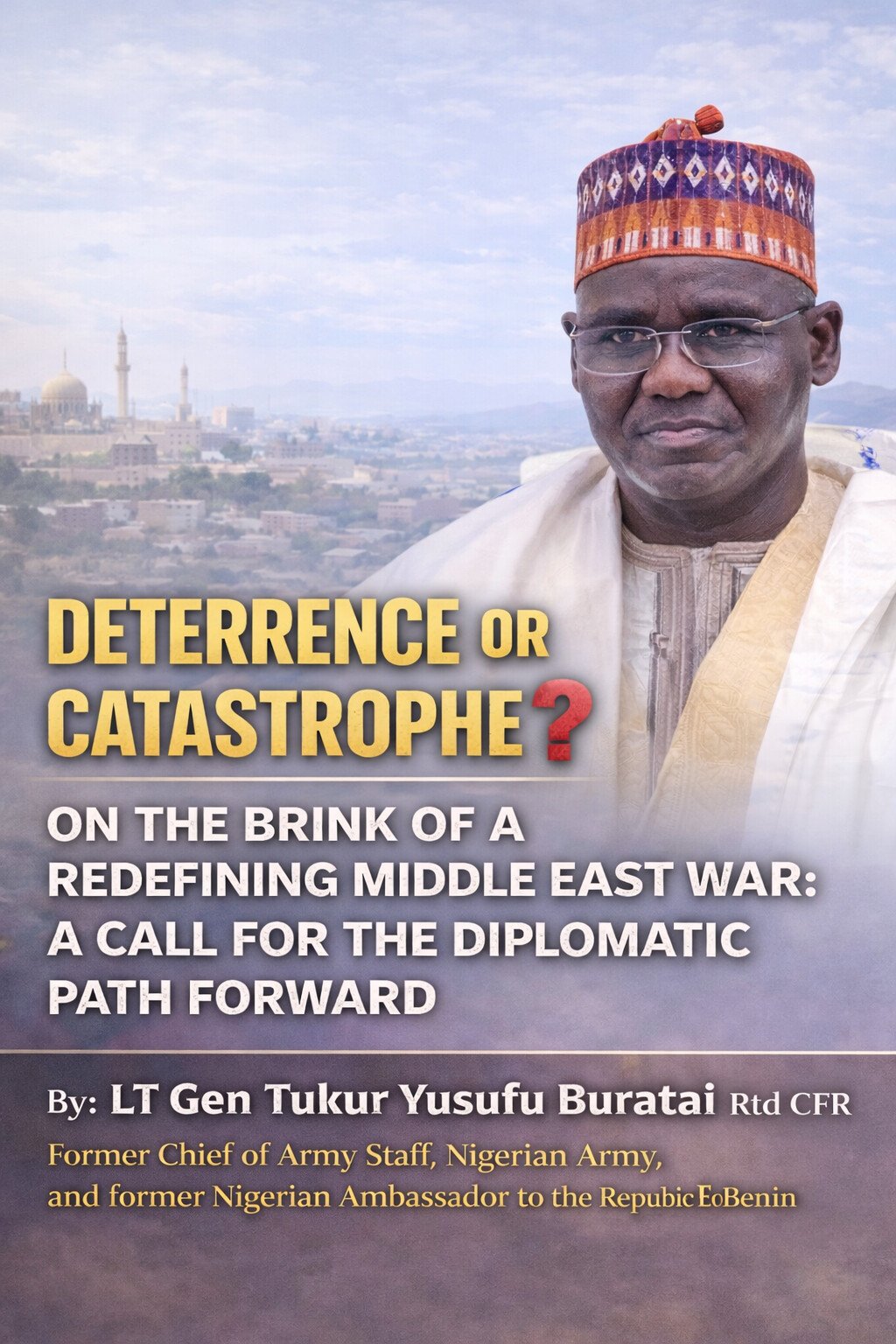
DETERRENCE OR CATASTROPHE? ON THE BRINK OF A REDEFINING MIDDLE EAST WAR: A CALL FOR THE DIPLOMATIC PATH FORWARD
We stand at a precipice where a single decision could redefine the future of the Middle East and send shockwaves through a fragile global order. The choice appears deceptively simple: to strike militarily in pursuit of deterrence or to withstand perceived aggression. Yet, this framing is a dangerous illusion. A direct, full-scale conflict between the United States, its allies, and Iran would not be a controlled exercise in power projection. It would be the ignition of a regional inferno with no clear exit, where the initial objective of "deterrence" would be consumed within hours by the unforgiving law of unintended consequences. The path of war promises not a decisive victory, but a cascade of devastation—human, economic, and strategic—that would leave all parties and the world profoundly poorer and more unstable. In this stark reality, diplomacy is not a sign of weakness; it is the singular, rational imperative for survival.
The Illusion of a Clear Victory
The allure of a military solution rests on a straightforward calculus: degrade critical nuclear and military infrastructure, cripple the command structures of the Islamic Revolutionary Guard Corps (IRGC), and deliver a blow so decisive that Iran's regional influence collapses. Proponents envision a rapid, surgical campaign that reestablishes undisputed deterrence. However, this vision fundamentally misjudges the nature of the adversary and the dynamics of the region. As former U.S. Deputy Assistant Secretary of State Andrew P. Miller cautions, even a successful strike "would likely prove a Pyrrhic victory" for broader strategic goals, failing to achieve durable political outcomes. Iran would not absorb a strike passively and capitulate. Retaliation would be swift, multidimensional, and devastating.
Indeed, as noted by Seyed Hossein Mousavian, a former Iranian nuclear negotiator and scholar at Princeton University, Tehran perceives such a confrontation as an "existential war," a stance that would "eliminate any incentive for restraint, unleashing a conflict that would be impossible to control." We would witness not a single battle but the violent opening of multiple, simultaneous fronts. Hezbollah's vast arsenal of precision-guided rockets would rain down on Israeli cities. Iranian proxies in Iraq and Syria would target the U.S. personnel and bases with relentless aggression. The Houthis could unleash further chaos on global shipping. Most critically, Iran itself would likely launch direct missile and drone attacks against Gulf state oil infrastructure and, potentially, attempt to blockade the Strait of Hormuz—a chokepoint for nearly 25% of global seaborne oil trade. The initial "surgical strike" would, within days, metastasize into a sprawling regional war with no defined battlefield and no clear rules of engagement.
The Unbearable Costs: A World Remade by War
The consequences would swiftly spiral beyond the military domain, etching a deep scar across global stability. The human cost would be immediate and horrifying, with casualties mounting not just among combatants but in urban centres targeted by long-range artillery and missiles. As analyzed by the BBC, a primary risk is the collapse of the Iranian regime into chaos or civil war," which would spark "a severe humanitarian and refugee crisis" of immense proportions, a scenario where "nobody wants to see the largest Middle East nation by population... descend into chaos."
The economic shock would be felt in every corner of the world. A successful disruption of the Strait of Hormuz, even temporarily, would trigger an instantaneous spike in oil prices, catapulting the global economy into a profound inflationary recession. Supply chains would seize, markets would panic, and the cost of basic necessities would skyrocket worldwide. This is not a speculative risk; it is a guaranteed outcome of Iran's stated asymmetric doctrine.
Strategically, the war would unmoor the region for a generation. The delicate, if tense, balance among regional powers would shatter. Even if the Iranian regime were severely weakened, the result would not be a peaceful vacuum but a vortex of chaos. As Afshon Ostovar, an associate professor at the Naval Postgraduate School, warns of potential internal collapse, "the ruling apparatus, in other words, would collapse gradually, and then suddenly." A fractured state could descend into civil conflict, its hardline elements unleashing terror networks, and rival powers scrambling to carve spheres of influence. The painstakingly built, if flawed, security architecture of the past half-century would lie in ruins. The ultimate outcomes of a strike are profoundly unpredictable, but none point toward a more stable or secure order for the United States, Israel, or their allies. Victory, in any meaningful sense, would be unrecognizable.
The Diplomatic Path: Not an Ideal, But a Necessity
Faced with this landscape of ruin, the diplomatic path emerges not as a naive ideal but as the only pragmatic tool for managing an existential threat. It is the circuit breaker for the escalatory spiral that guarantees mutual destruction. This is not an argument for appeasement or for trusting the untrustworthy. It is a cold-eyed recognition that only through calibrated statecraft can we navigate away from the brink. This view is echoed by regional voices, such as an editorial in The National, which asserts that "various regional actors are urging non-military ways to change relationships with Tehran" and that "now is a time for focused and determined diplomacy to chart a path away from war."
The goal of diplomacy in this context is not to achieve a grand reconciliation overnight but to relentlessly pursue de-escalation and create mechanisms for crisis management. It involves empowering regional dialogue, establishing clear and direct communication channels to prevent miscalculation, and seeking hard-nosed, verifiable agreements that incrementally roll back the most dangerous threats, such as further advances in Iran's nuclear program and its regional ballistic missile deployments. The international community, including powers with leverage in Tehran, must be rallied not to take sides but to unequivocally advocate for restraint. The collective message must be that while aggression and proliferation are unacceptable, the alternative of total war is a common enemy that will destroy all in its path.
The choice before the international community is now laid bare. One road leads into the fog of war—a fog filled with the echoes of missile fire, the screams of the displaced, and the collapse of economies. It is a path where the very concept of "victory" loses all meaning. The other road, the diplomatic path, is undeniably difficult, fraught with setbacks, and requires immense political courage. It demands negotiating through distrust and managing imperfect outcomes. But it is the only road that leads away from the abyss and toward a future where stability, however fragile, can be rebuilt. The hour is late, but the path forward remains. We must choose diplomacy, not because we believe in the goodness of our adversaries, but because we have stared into the alternative and seen an unbearable catastrophe for all.
By:
Lt Gen Tukur Yusufu Buratai Rtd CFR
Former Chief of Army Staff, Nigerian Army, and former Nigerian Ambassador to the Republic of Benin.