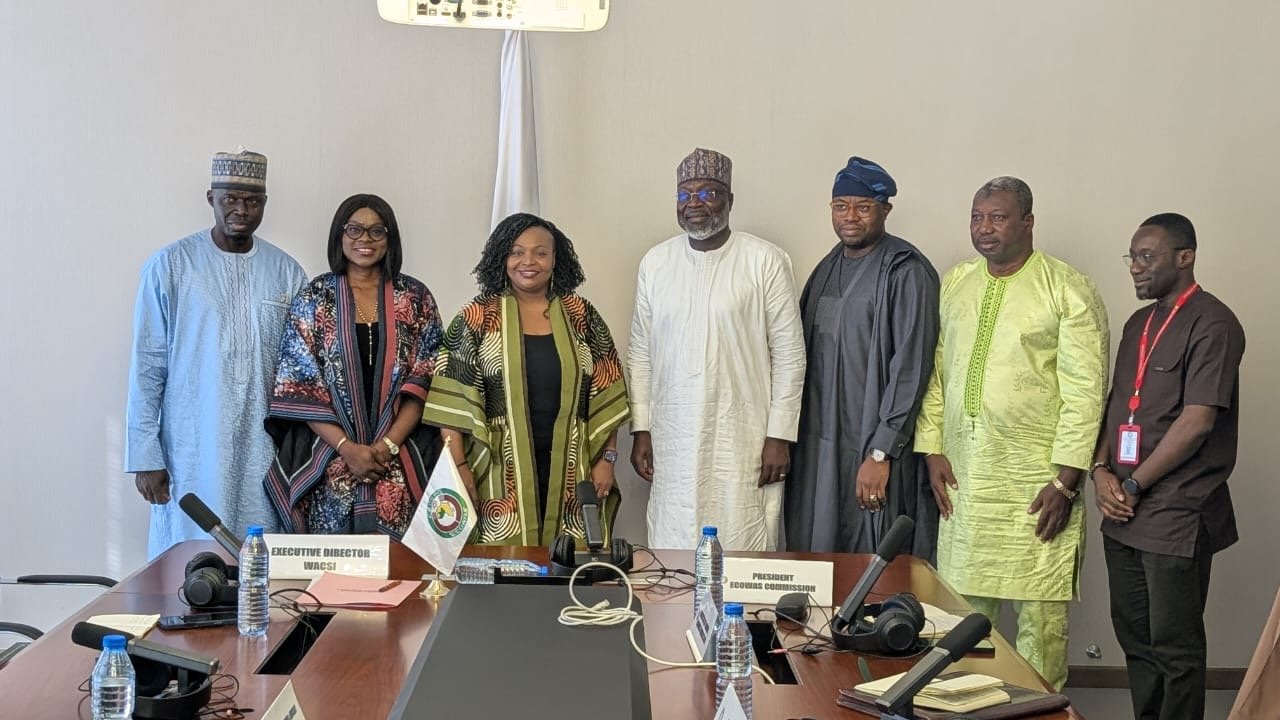
ECOWAS, WACSI seal landmark pact to strengthen civil society's role in regional integration
By: Zagazola Makama
The Economic Community of West African States (ECOWAS) Commission has signed a landmark Memorandum of Understanding (MoU) with the West Africa Civil Society Institute (WACSI), reaffirming its commitment to placing citizens at the heart of regional integration even as the bloc navigates the political consequences of the withdrawal of Burkina Faso, Mali and Niger.
The agreement, signed in Abuja on Friday, formalises a long-standing relationship between the regional organisation and the Ghana-based institute, creating a framework for collaboration on conflict prevention, democratic governance, peacebuilding, civic participation, digital governance and institutional capacity building.
Speaking at the ceremony, the President of the ECOWAS Commission, Dr Omar Alieu Touray, insisted that despite the departure of the three Sahel states from the 15-member bloc, the peoples of the region remain deeply connected.
"It's a divorce without leaving the house," Touray remarked, drawing laughter from the audience before explaining that while governments may have taken different political paths, the social, economic and cultural ties binding West Africans remain strong.
He stressed that ECOWAS would continue to engage citizens across the region, saying the organisation's vision of integration could only succeed with an active and vibrant civil society.
"We continue to open our doors to the people," Touray said, adding that civil society organisations remain indispensable partners in promoting democratic governance, accountability and sustainable development.
The ECOWAS Commission President described the MoU as "far more than a formal agreement", saying it represents "a shared commitment to partnership, dialogue and collective action in pursuit of a peaceful, democratic, prosperous and resilient West Africa."
According to him, the partnership comes at a critical time as the region grapples with unconstitutional changes of government, violent extremism, fragile political transitions, shrinking civic space, youth unemployment, climate-induced pressures and declining development financing.
"These challenges demand stronger partnerships, innovative approaches and coordinated responses that draw on the comparative strengths of governments, regional institutions and civil society," he said.
Touray said the agreement would strengthen ECOWAS' preventive diplomacy architecture by leveraging the knowledge and reach of civil society to improve early warning systems, anticipate governance and security risks, and promote peaceful democratic transitions anchored on constitutional rule. He added that the collaboration would also deepen citizen engagement, protect civic freedoms, empower women and young people, strengthen civil society institutions and promote responsible digital governance in line with ECOWAS Vision 2050.
In her response, WACSI Executive Director, Dr Nana Asantewa Afadzinu, described the agreement as an "epochal" milestone that demonstrates ECOWAS' determination to transform itself into "an ECOWAS of peoples."
"For us, it's bigger than WACSI," she said.
"ECOWAS has been established with a very clear direction that it is not just an ECOWAS of Heads of State, but actually an ECOWAS of peoples."
Afadzinu said WACSI's vision of a peaceful, secure and prosperous West Africa driven by its people aligns perfectly with that of ECOWAS, adding that citizen participation has always been central to the institute's mission.
"The people element is what drives us," she said. "Your engaging us in this manner and wanting to deepen this relationship shows your commitment to engaging with the people in looking at the issues affecting this region."
She noted that WACSI, established in 2005, has worked closely with ECOWAS for nearly two decades, supporting initiatives such as the ECOWAS Conflict Prevention Framework, strategic planning processes, civil society engagement in policy formulation and consultations on the establishment of the proposed ECOWAS Economic and Social Council (ECOSOCC).
"We are no strangers to ECOWAS," Afadzinu said. "But what this MoU does is really strengthen that bond and also give us, to some extent, a certain mandate—with the blessing of ECOWAS—to bring civil society closer to this institution that we truly believe in."
Despite the political and security challenges confronting the sub-region, she said WACSI remains confident in the regional body's future.
"In spite of all the challenges, we believe in this institution, and we want it to succeed," she declared.
Afadzinu said the partnership would also help bridge the knowledge gap between ECOWAS and civil society organisations, describing the relationship as a two-way process.
"There are ways that you could enable us to understand better how this institution works. That's what civil society needs to understand. But also for ECOWAS to understand civil society. It's a two-way affair."
Both leaders agreed that the value of the agreement would ultimately be measured not by the ceremony but by the impact it delivers for the people of West Africa.
"The true value of this Memorandum will be measured not by its signing but by the tangible results it delivers for the people of West Africa," Touray said, urging both institutions to move swiftly from commitment to implementation.
The partnership is expected to provide a structured platform for joint initiatives on peace and security, democratic governance, human rights, civic participation, digital innovation and institutional strengthening, reinforcing ECOWAS' long-term ambition of building a peaceful, inclusive and resilient West Africa anchored on the active participation of its citizens.