EXCLUSIVE: Troops kill ISWAP top Shura council member Bako Gorgore in Borno
By: Zagazola Makama
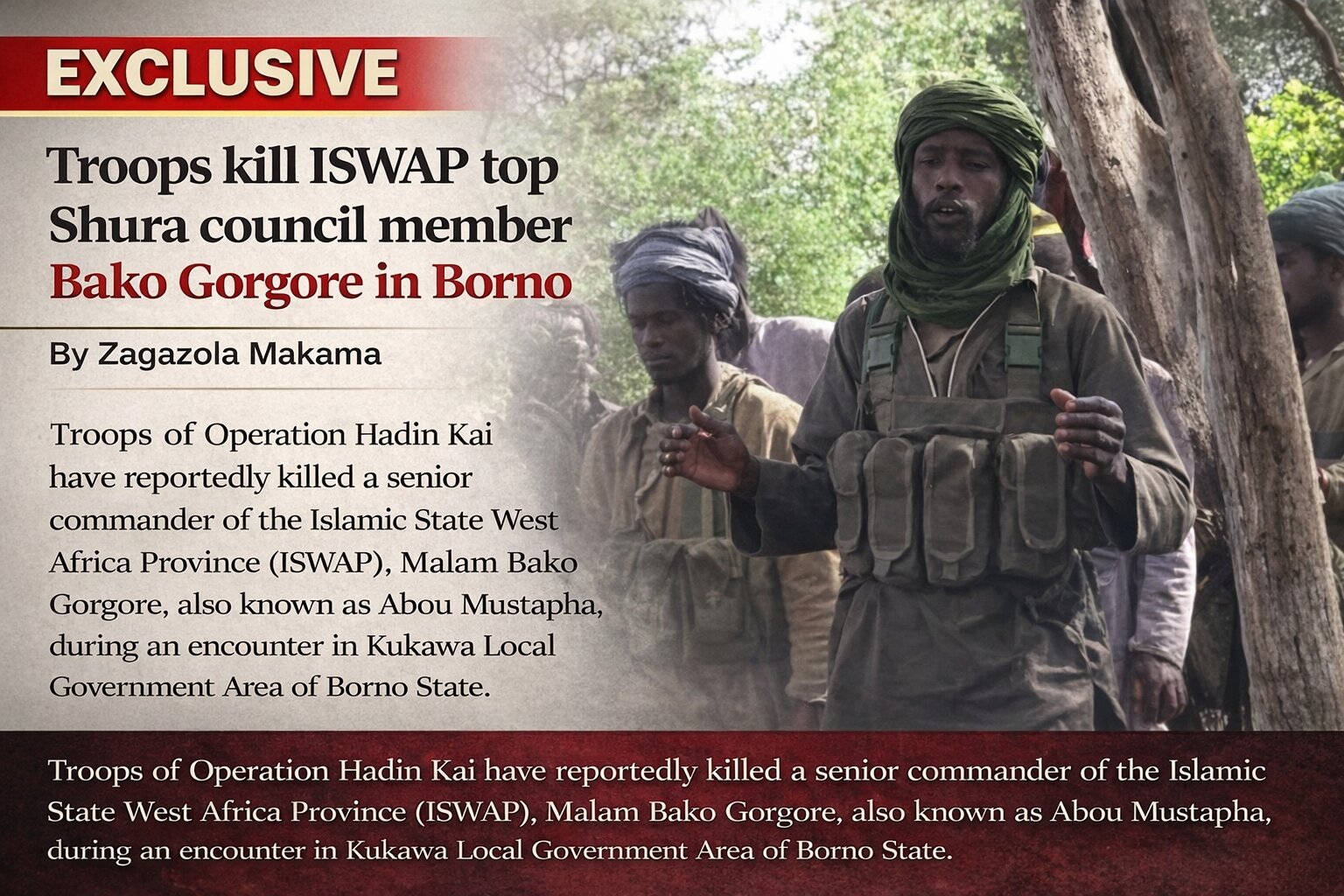
Troops of Operation Hadin Kai have reportedly killed a senior commander of the Islamic State West Africa Province (ISWAP), Malam Bako Gorgore, also known as Abou Mustapha, during an encounter in Kukawa Local Government Area of Borno State.
Security sources said Gorgore, believed to be about 60 years old, was killed during an encounter with troops in Kukawa Local Government Area of Borno, a region bordering the Lake Chad basin that has long served as a strategic hub for insurgent operations.
The development was reportedly confirmed through multiple intelligence channels after security operatives intercepted internal communications among ISWAP fighters acknowledging his death.
Gorgore was regarded as one of the longest-serving figures within the insurgency that began under the late Boko Haram founder, Mohammed Yusuf, in the early 2000s. Originally from Yunusari Local Government Area of Yobe State, he rose steadily through the ranks to become one of the most influential commanders within the ISWAP hierarchy.
Over the years, he occupied several strategic operational and leadership roles within the group, particularly in the Timbuktu Triangle, the vast forested and marshland region stretching across northern Borno near Lake Chad.
Between 2018 and 2021, he reportedly served as the overall commander responsible for the Faruuk axis in the Timbuktu Triangle following the tenure of another insurgent commander, Mustapha Krimima. During that period, intelligence assessments described Gorgore as one of the key operational planners responsible for coordinating insurgent movements and logistics across the Lake Chad region.
Role in the fall of Abubakar Shekau
One of the most defining episodes associated with Gorgore was the internal conflict within the Boko Haram movement that culminated in the death of Abubakar Shekau, the notorious leader of Jama’atu Ahlis Sunna Lidda’awati wal-Jihad (JAS). Security sources say Gorgore was among the senior ISWAP commanders who led fighters into Sambisa Forest in 2021, during the confrontation that forced Shekau into a final standoff.
According to intelligence reports at the time, Shekau detonated an explosive device during the confrontation in Tokumbere area of Sambisa, killing himself and some of his loyalists rather than surrender to the ISWAP faction. The incident dramatically reshaped the insurgent landscape in the North-East, weakening the JAS faction while strengthening ISWAP’s operational dominance in parts of Borno State.
Rise to ISWAP’s top leadership circle
Following the restructuring of ISWAP leadership after the Sambisa events, Gorgore continued to consolidate his influence within the organisation.
By 2022, he was elevated to the Shura Council, the highest decision-making body within the group, operating under the broader command structure aligned with the Islamic State’s global leadership.
Before his elevation to the council, he reportedly served as Amir Jaysh (military commander) in the Timbuktu Triangle after Mustapha Krimima.
His responsibilities included supervising combat operations, managing fighters, and coordinating activities across the Lake Chad “Tumbumma” enclaves a network of islands and marshlands long used as insurgent hideouts.
Previous death rumours
Interestingly, Gorgore had previously been reported dead in 2022, when intelligence suggested he was killed in a Nigerian Air Force airstrike targeting ISWAP positions in the Lake Chad region. However, subsequent intelligence assessments indicated that he survived the strike with injuries and later resurfaced within the group’s command structure. His reappearance at the time reinforced perceptions of him as one of the more resilient and elusive figures within the insurgency.
The confirmed killing of Gorgore could have important implications for the leadership cohesion of ISWAP. As a senior Shura member with deep operational experience dating back to the early Boko Haram years, his removal potentially disrupts command continuity within the group.
The insurgency in the Lake Chad region has historically depended on experienced commanders capable of navigating the complex terrain and maintaining loyalty among fighters.
The death of a veteran figure like Gorgore weakens institutional memory within the insurgent network. It may also trigger internal power struggles as younger commanders compete to fill the vacuum.”
Beyond the operational impact, the death of Gorgore also carries symbolic significance.
As one of the few surviving commanders linked to the original Boko Haram leadership under Mohammed Yusuf, his removal represents the gradual erosion of the insurgency’s old guard.
While ISWAP retains operational capabilities and continues to mount attacks in parts of the North-East, the loss of senior figures like Gorgore is expected to complicate its internal command dynamics. The coming months will reveal whether the group can quickly replace such experienced leadership or whether the loss will translate into reduced operational cohesion within its ranks.