FACT CHECK: Viral Video Mocking Nigerian Troops Is Misleading, Dangerous Propaganda — Not Reality
By Zagazola Makama
A viral video circulating on social media, in which a content creator identified as “Za Baba” mockingly portrays a supposed soldier captured by bandits, has been confirmed as FALSE, misleading, and dangerously irresponsible.
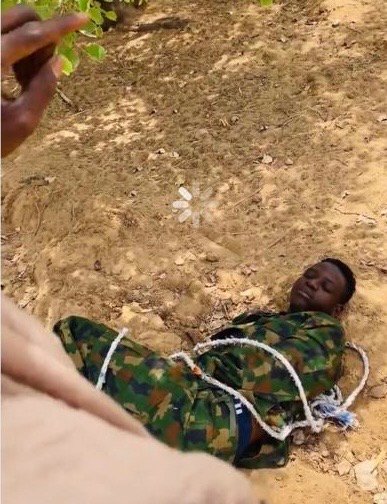
In the video, the individual uses derogatory language to depict Nigerian soldiers as weak, while glorifying bandits as “warriors.” He further dramatizes a fake scenario of a captured soldier, tied with ropes, taunts and mock sympathy, in what appears to be a staged and scripted performance designed purely for attention and virality.
There is no evidence that the video reflects any real incident. Field checks show no record of such an occurrence. The content creator had also used similar costume to act as bandit in his other videos while another individual acted as a soldier.
The clip is therefore nothing more than fabricated content packaged designed to provoke emotions, mislead the public, and undermine confidence in security forces.
What makes this even more troubling is not just the falsehood but the intent. In a country battling insurgency and banditry, portraying terrorists as heroes while ridiculing national troops is not “content creation” it is reckless amplification of enemy narratives.
The Nigerian military operates in some of the most hostile environments imaginable, confronting heavily armed groups daily. These are men and women who risk and often lose their lives to keep communities safe. Reducing that sacrifice to cheap mockery for clicks is not satire, it is disgraceful.
The individual behind the video was reckless. There is a difference between freedom of expression and irresponsible messaging that emboldens criminals and demoralises those on the frontlines.
Content creators must understand that influence comes with responsibility especially in matters of national security.
Equally concerning is how quickly some bloggers and social media users amplified the clip without verification, using it to attack the military. This reflects a growing trend where falsehood spreads faster than truth, especially when it feeds outrage.
The public is strongly advised to treat such viral content with caution. Not everything seen online is real and in many cases like this, it is deliberately crafted to distort reality.
Nigeria’s security challenges are real. But so too are the sacrifices of those confronting them. Mocking that effort while romanticising terrorists is not just wrong, it is dangerous.