Stakeholders seek end to ethnic profiling in security discourse
By: Zagazola Makama
Security stakeholders have called for the elimination of ethnic profiling in conflict narratives and security operations across West Africa, warning that imprecise language fuels violence and undermines national stability.
Across Nigeria’s conflict-prone regions, words have become as consequential as weapons.
From the North-West to the North-Central, the language used in describing violence, often framed along ethnic or communal lines has increasingly come under scrutiny, with experts warning that such narratives risk deepening divisions and prolonging conflicts.
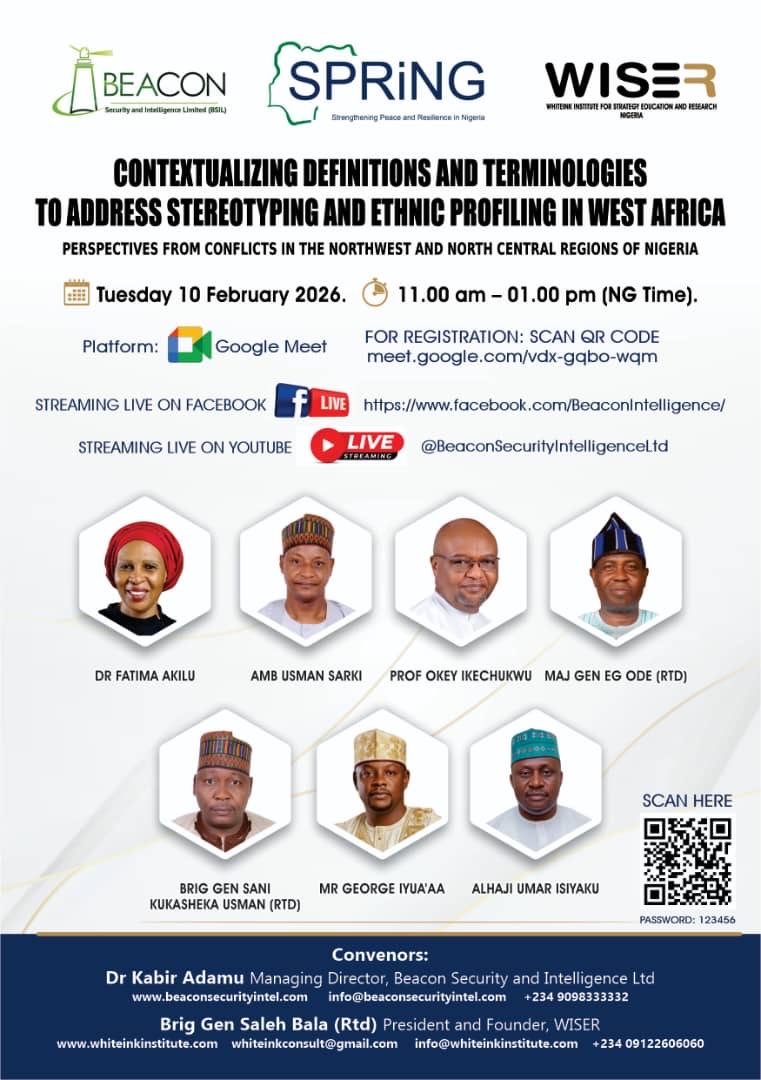
It was against this backdrop that Beacon Security and Intelligence Limited and Whiteink Institute for Strategy Education and Research, with support from the UKAid-funded Strengthening Peace and Resilience in Nigeria (SPRiNG) project, convened a high-level virtual dialogue to rethink how security conversations are framed in West Africa.
The forum, held on Feb. 10, brought together voices from across the military, academia, civil society and local communities to interrogate a critical question: can better language lead to better security outcomes?
Opening the session, Dr. Ukoha Ukiwo, Team Leader of the SPRiNG project, highlighted findings from recent studies linking hate speech and divisive narratives to the persistence of violence in Nigeria.
He warned that poorly framed terminology especially those that generalise criminal behaviour along ethnic lines can undermine peacebuilding efforts and even trigger further conflict. “Conflict sensitivity is key,” he noted, stressing that language, if not carefully deployed, can cause interventions to “boomerang.” For many participants, this concern is not theoretical. In communities affected by banditry and communal clashes, labels have often blurred the line between perpetrators and innocent civilians.
Dr. Fatima Akilu of the Neem Foundation argued that identity-based labels are rarely neutral, noting that they often flatten complex realities and reinforce marginalisation.
According to her, branding entire groups based on the actions of a few not only fuels resentment but also complicates reconciliation efforts. This position was echoed by Amb. Sarki Usman, who warned that ethnic profiling is not only socially harmful but also strategically counterproductive.
By alienating communities, he said, such narratives weaken trust and reduce the flow of actionable intelligence to security agencies.
From a military perspective, the implications are profound. Retired Maj.-Gen. E.G. Ode called for a shift in operational thinking that integrates cultural awareness and accountability into frontline engagements.
He noted that modern counterinsurgency requires not just firepower but also an understanding of the social environment in which operations are conducted.
Similarly, Brig.-Gen. Sani Kukasheka Usman (Rtd) urged the media to adopt more responsible reporting practices, emphasising the need to focus on criminal acts rather than ethnic identities.
Mr. George Ilyua’a, a community leader from the North-Central, stressed that behaviour-based terminology is essential to protect innocent civilians from being wrongly targeted or stigmatised.
He noted that restoring trust between communities and security agencies depends largely on how conflicts are described and understood.
The dialogue, which attracted about 70 participants, concluded with a consensus on the need for a more precise and conflict-sensitive vocabulary in security operations and public discourse.
Organisers said the insights generated would feed into a broader initiative, including a physical conference scheduled for April 1 and April 2 in Abuja.
The event is expected to produce a policy brief and a practical toolkit aimed at guiding language use across defence, law enforcement, judicial institutions, the media and educational sectors.
According to the conveners, these tools will serve as a foundation for reshaping narratives in ways that enhance human intelligence (HUMINT), reduce tensions and support long-term peacebuilding.
In a joint statement, Dr. Kabir Adamu of Beacon Security and Intelligence Limited and Brig.-Gen. Saleh Bala (Rtd) of Whiteink Institute for Strategy Education and Research called on all stakeholders to support efforts aimed at neutralising ethnic profiling in security discourse.