Nigeria confronts ethnic profiling as security experts seek new communication framework
By: Zagazola Makama
A high-level conference in Abuja is placing renewed focus on the role of language, perception, and narrative framing in shaping security outcomes across West Africa, as stakeholders warn that ethnic profiling could undermine counterterrorism efforts.
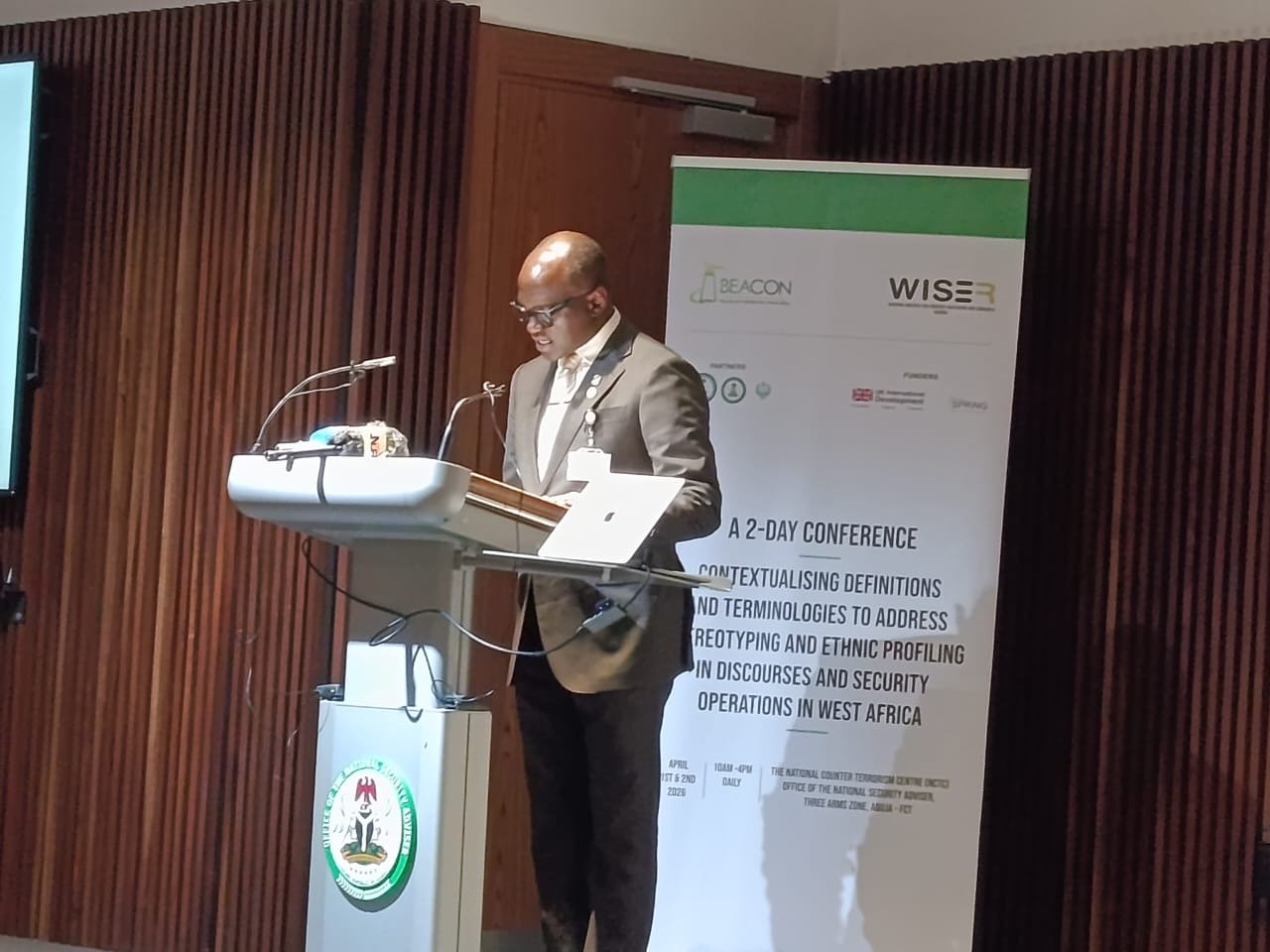
The two-day conference, hosted at the National Counter Terrorism Centre under the Office of the National Security Adviser, brings together security experts, policymakers, academics and civil society actors to interrogate the implications of stereotyping in security discourse.
Organised in collaboration with Beacon Security and Intelligence Limited and Whiteink Institute for Strategy Education and Research Nigeria, the forum reflects growing concern that prevailing narratives may be inadvertently deepening divisions in already fragile societies.
The timing of the conference is significant, coming at a period when countries in the region are battling complex threats ranging from insurgency to transnational organised crime, all of which require strong community cooperation.
In his remarks, the National Coordinator of the Centre, Maj.-Gen. Adamu Laka, stressed that modern security operations extend beyond kinetic responses, noting that the language used in describing threats can either strengthen or weaken public trust.
Security experts at the conference observed that broad generalisations and labels often attached to specific ethnic or religious groups risk alienating communities whose support is critical for intelligence gathering and operational success.
“When communities feel targeted or profiled, they are less likely to cooperate with security agencies, and that creates gaps that adversaries can exploit,” an analyst noted.
The conference also examined the role of the media and digital platforms in amplifying narratives, with participants warning that unverified or poorly framed reports could reinforce stereotypes and escalate tensions.
According to experts, the proliferation of social media has accelerated the spread of simplified narratives that often ignore the complexity of security challenges, thereby fuelling suspicion and mistrust among communities.
Executive Director of the Whiteink Institute, Brig.-Gen. Saleh Bala (rtd), said the objective of the conference was to critically assess how “profiling and name-calling” have contributed to heightened insecurity and social fragmentation.
In a multi-ethnic societies like Nigeria and across West Africa, the consequences of such narratives can be far-reaching, potentially transforming localised security incidents into broader ethnic or religious conflicts.
They emphasised that counterterrorism strategies must incorporate inclusive communication approaches that recognise the diversity of affected communities while avoiding language that could stigmatise entire populations.
Participants are also exploring best practices in strategic communication, including the development of context-sensitive terminologies that reflect operational realities without reinforcing bias.
“There is a need to move from simplistic labels to more precise and evidence-based descriptions of threats,” another expert said.
Beyond discourse, the conference is expected to produce actionable recommendations aimed at guiding both policy formulation and operational conduct among security agencies and media practitioners.
Such frameworks could help standardise communication, reduce misinformation, and enhance coordination among stakeholders.
Importantly, the discussions point to a broader shift in security thinking, where narrative control and information management are increasingly seen as critical components of national security architecture.
Experts warn that failure to address the issue of ethnic profiling could not only erode public confidence but also complicate ongoing efforts to counter violent extremism.
As deliberations continue, stakeholders agree that building trust between communities and security institutions remains central to sustainable peace.


