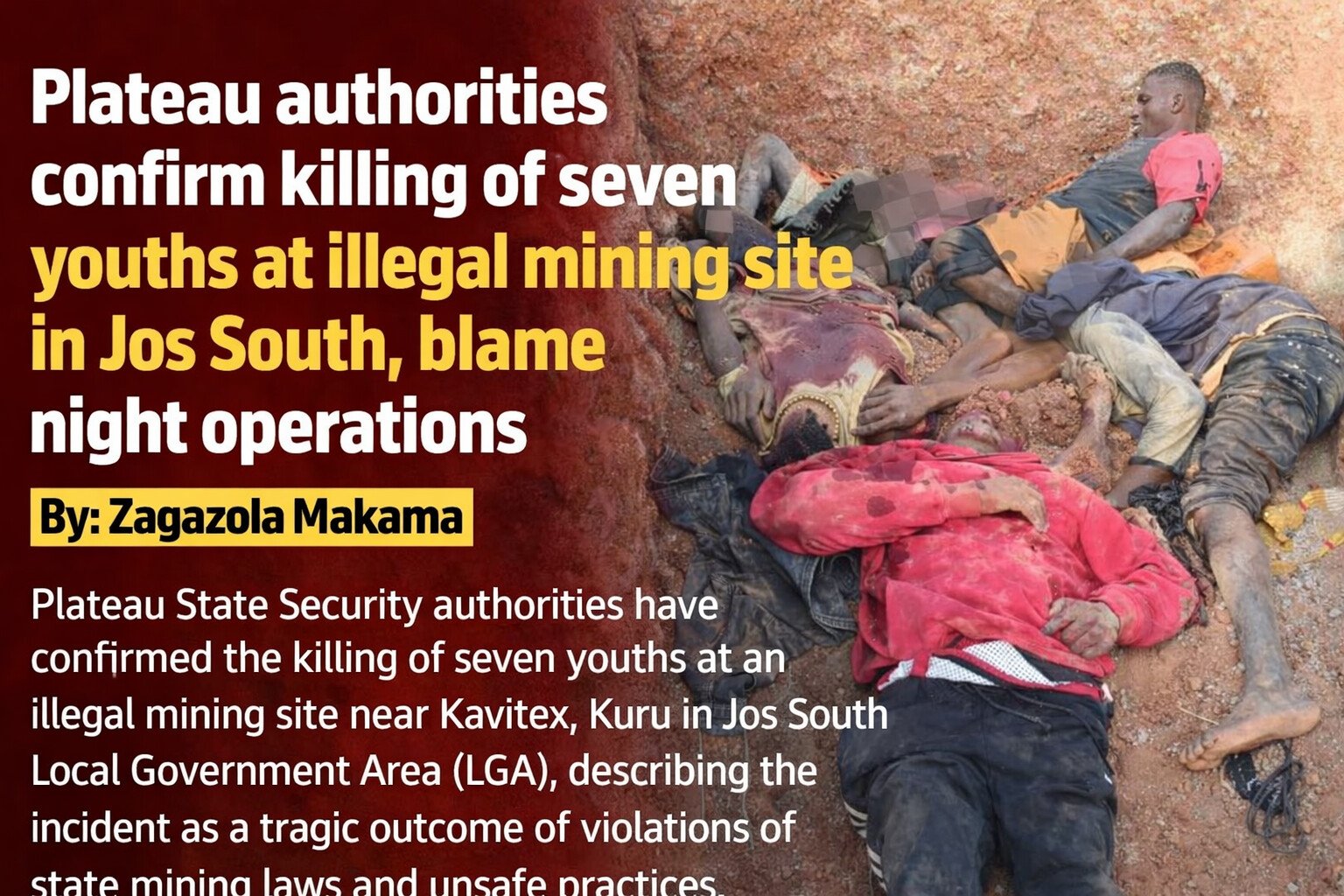
Plateau authorities confirm killing of seven youths at illegal mining site in Jos South, blame night operations
By: Zagazola Makama
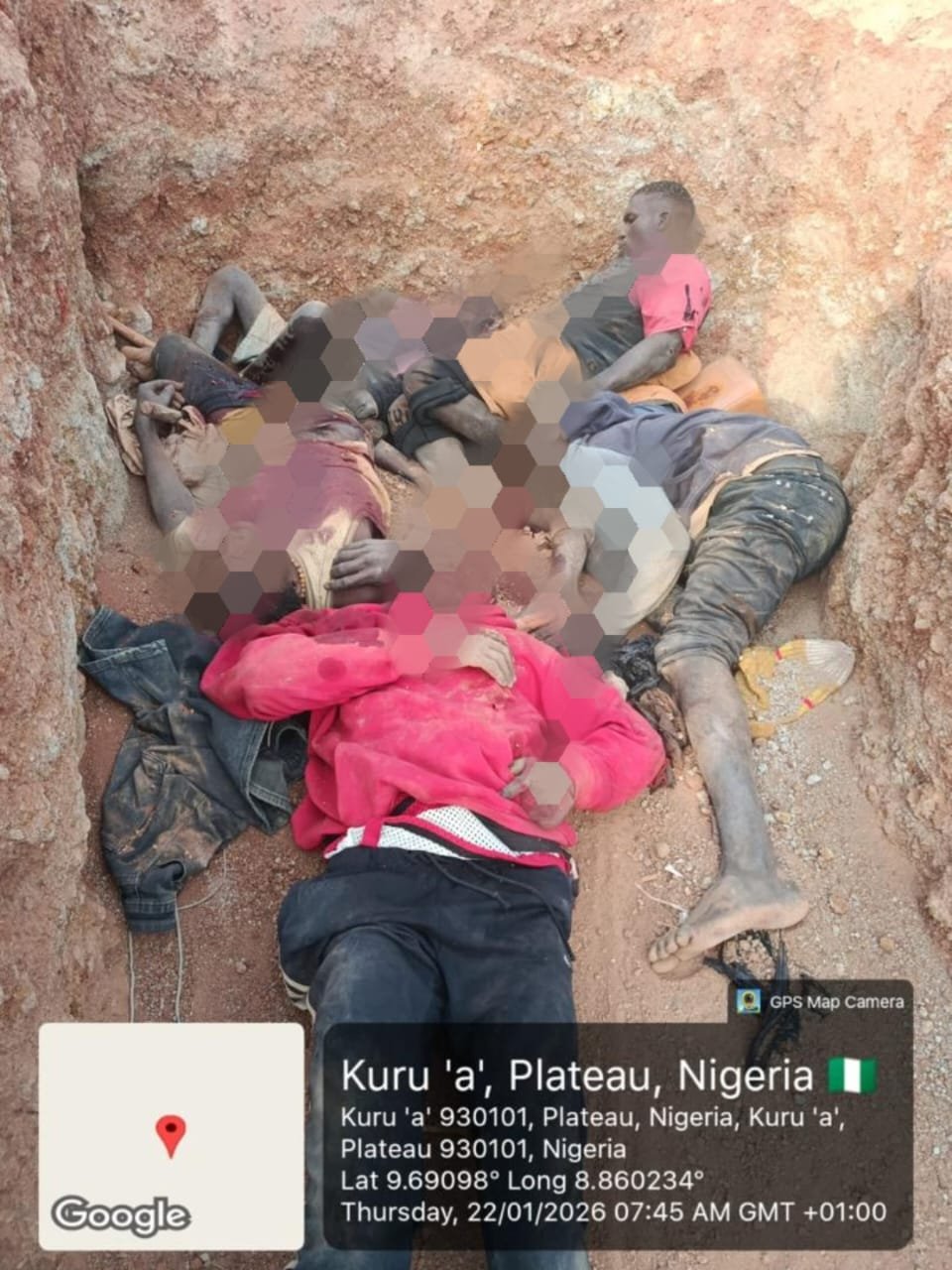
Plateau State Security authorities have confirmed the killing of seven youths at an illegal mining site near Kavitex, Kuru in Jos South Local Government Area (LGA), describing the incident as a tragic outcome of violations of state mining laws and unsafe practices.
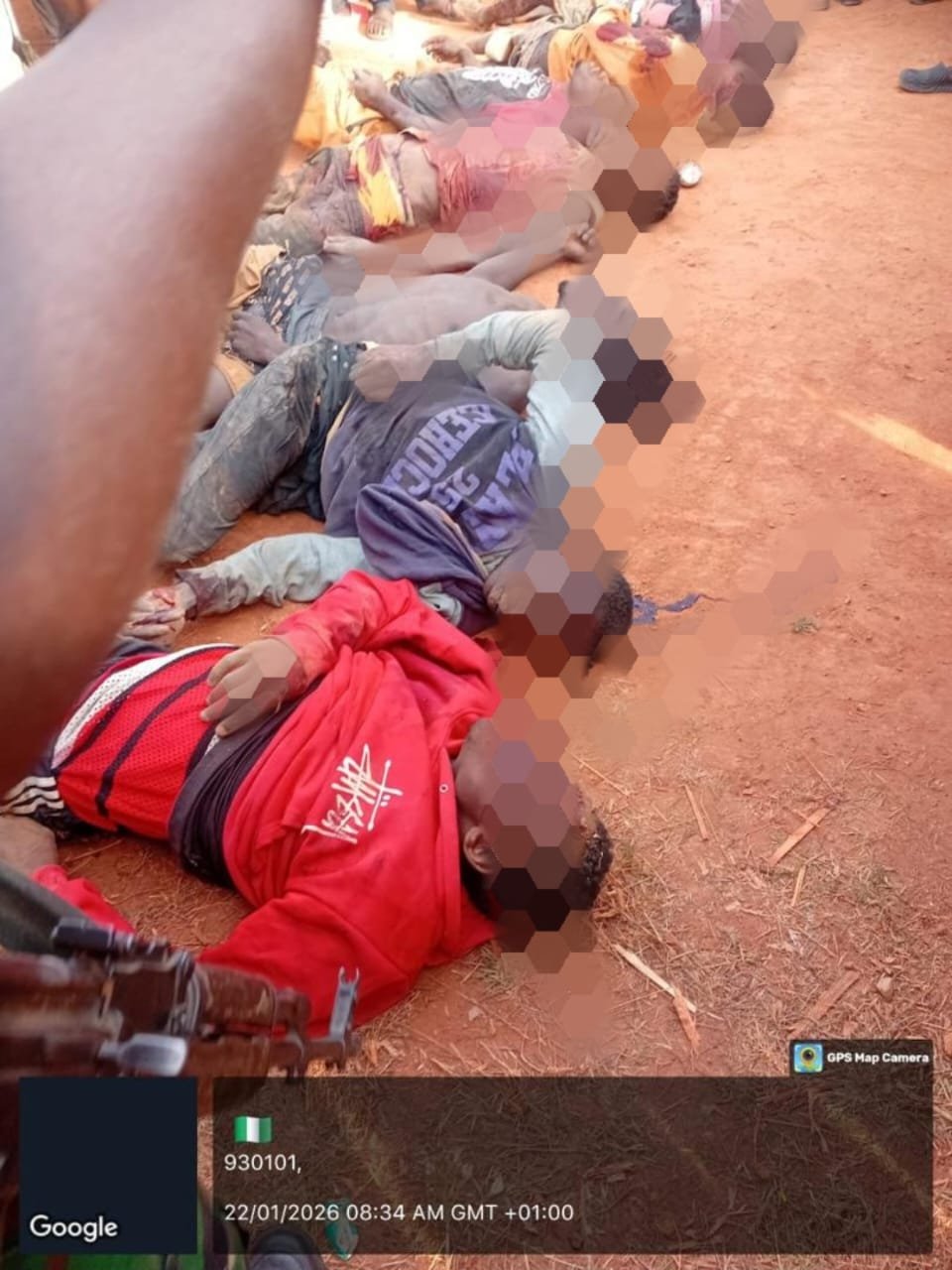
A Police sources told Zagazola Makama that the victims, Dung Gyang, 19; Weng Dung, 26; Francis Paul, 25; Samuel Peter, 22; Dung Simon, 28; Pam Dung, 23; and Francis Markus, 15 were shot dead by yet-to-be-identified armed men at about 2:00 a.m. on Thursday while engaging in illegal mining activities.
The sources said that the troops of Sector 6, Operation Safe Haven (OPEP), and the police
immediately mobilized to the site and conducted a thorough sweep of the area.
At the scene, they discovered ten spent cases of 7.62mm ammunition, indicating that the attackers were heavily armed. The corpses were subsequently moved to the Primary Health Care Centre, Dabwak, Kuru, to allow the families to make burial arrangements.
Preliminary investigations by security forces indicate that the attackers may have targeted the site to seize illegally mined minerals from the closed mining location at Capitex Kuru.
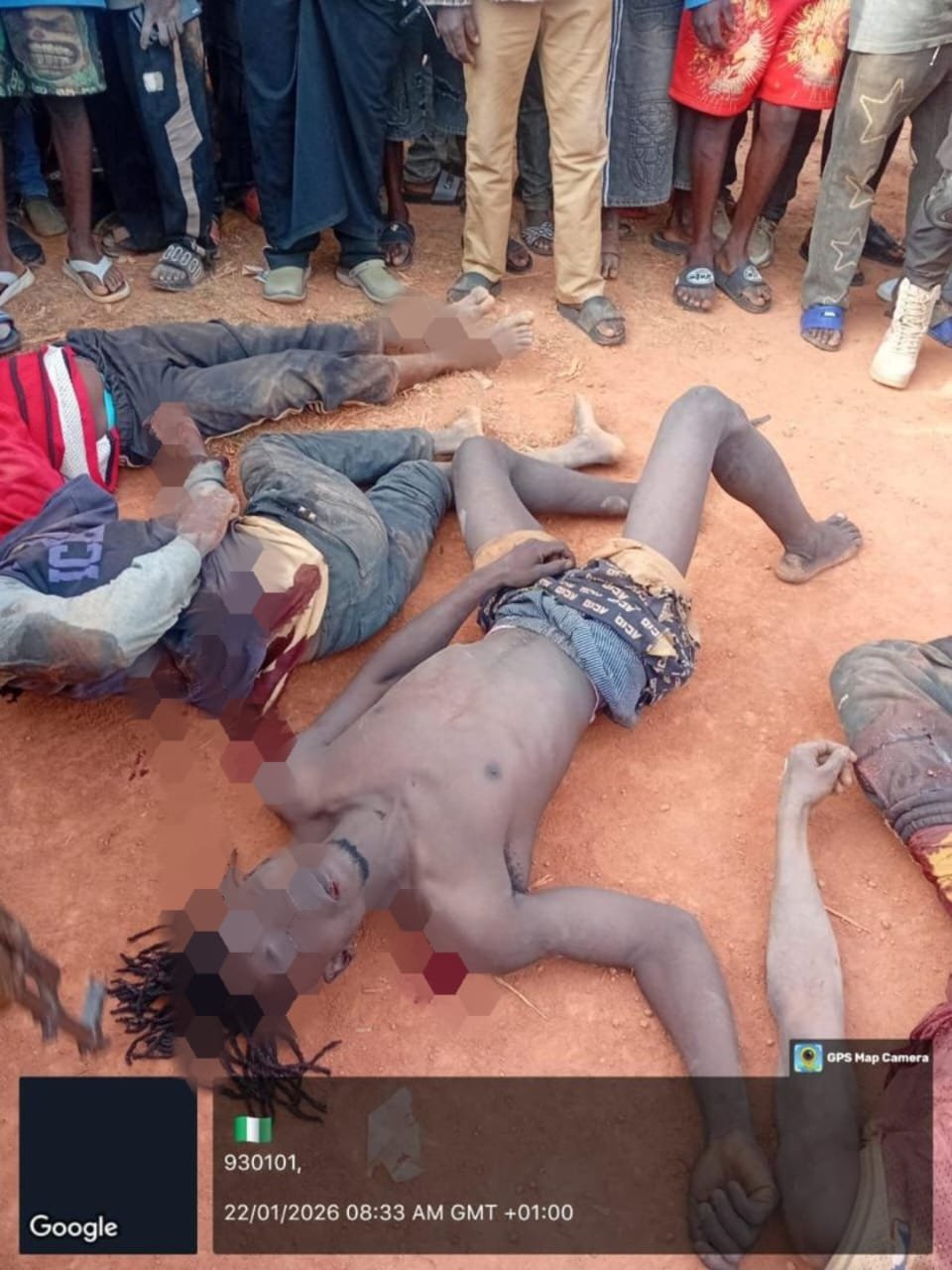
Security sources said the victims’ decision to remain at the mining site late into the night in violation of Plateau State’s ban on night and illegal mining made them particularly vulnerable.
“The miners’ continued operations in contravention of the extant laws, combined with the clandestine nature of illegal mining, significantly increased their exposure and contributed to this tragic outcome,” the security sources said.
Authorities further observed that an estimated eight-hour delay in reporting the incident to the security authorities likely stemmed from fear of sanctions associated with the prohibition of night mining.
Officials warned that delayed reporting often reduces the ability of security personnel to respond quickly, giving perpetrators a tactical advantage.
In response to the attack, troops of Sector 6 OPEP have intensified both kinetic and non-kinetic operations in the area. Sustained patrols, intelligence-driven offensive measures, and community engagement efforts are being conducted to identify, track, and apprehend the perpetrators, as well as to address underlying conflict triggers in the community and forestall further attacks.
The police on the other hand reiterated its commitment to restoring law and order, stating that security would maintain a strong presence in Kuru and other mining communities to prevent breakdowns of security.
Authorities also urged residents to cooperate with security agencies by providing timely information on suspicious movements or criminal activities, warning that fear of sanctions should not prevent reporting.
On the other hand sources from the Plateau State Government reiterated that enforcement of mining laws is essential to protect both miners and the general public. Officials appealed to youths to comply with existing regulations, including the prohibition on night mining, and to operate only at officially sanctioned sites under regulated conditions.
The Kuru killings are the latest in a series of attacks across Jos South, Barkin Ladi, and Riyom LGAs, where illegal mining sites have repeatedly become targets for armed groups seeking to exploit soft target in an intensified circle of violence in Plateau state.
Meanwhile, Zagazola Makama linked the attack to the latest in a spiral of violence in plateau in what began as disputes over land and livelihoods has metastasized into a tit-for-tat pattern where cattle rustling, livestock poisoning and armed raids trigger swift reprisals, dragging entire communities into a vortex of fear. Gakok attack did not erupt in isolation. It is the tragic crest of a wave that has been rising across the Barkin Ladi–Riyom–Jos South axis for weeks.
The current escalation tracks back to Wednesday, Jan. 14, when no fewer than 102 cows were rustled at Dan Sokoto in Ganawuri District, Riyom LGA. Witnesses said armed men suspected to be Berom Militia stormed the area in broad daylight, forcing herders to flee and driving the cattle away at gunpoint. The animals reportedly belonged to two pastoral families from Jos East, but were seized in Ganawuri, an inter-LGA fault line that complicated response and recovery.
Local accounts allege the attackers came from Vom District in Jos South. The Dan Sokoto raid was not an aberration. In the same month, at least seven cows were poisoned in Kwi village (Riyom LGA), while three others were shot dead near Kuru Gadabiyu in Barkin Ladi. Each incident deepened attacks and retaliation.
Days after the Dan Sokoto rustling, violence crossed from fields to homes. In the early hours of Saturday, at about 2:30 a.m., gunmen attacked Kasuwa Denkeli village in Barkin Ladi LGA. One person was killed on the spot; two others sustained gunshot wounds and were rushed to the Jos University Teaching Hospital. Police confirmed the incident, said a team led by the DPO moved to the scene, and announced an investigation to track the perpetrators.Residents linked the assault to retaliation over the stolen cattle in neighbouring Riyom.
This pattern attack on herds, reprisal on villages has repeated with grim regularity. On Jan. 6, coordinated attacks on Jol community in Riyom and Gero in Gyel District of Jos South left three people dead. The violence followed the shooting of two Fulani youths earlier that day in Jos South, one of whom later died. Witnesses described the ambush as unprovoked. What followed was swift retaliation and counter-retaliation, with communities caught in the crossfire.
The warning signs were already flashing in December. On Dec. 12, more than 130 cattle were reportedly rustled in Nding community. Around the same period, livestock poisoning was recorded in parts of Jos East and Riyom LGAs. Those incidents were followed by deadly clashes, including the killing of four children in Dorong village, Barkin Ladi LGA, and attacks on Gero that left deaths, injuries and the loss of more livestock.
On Dec. 16, an attack on an illegal mining site in Tosho, Barkin Ladi LGA, left 12 miners dead and others abducted. Security sources linked the violence to earlier rustling of 171 cattle belonging to Fulani. Again, a familiar sequence: cattle taken, emotions inflamed, guns answer.
Across Barkin Ladi, Riyom and Jos South, residents now speak of “no-go” zones. Areas like Vwang in Jos South and parts of Fan District in Barkin Ladi are whispered about as holding grounds for rustled cattle belonging to the Fulani.The claims, wether true or not, reinforce suspicion and hinder cooperation. Recovery becomes harder; rumours spread faster than facts.
Security agencies respond to each incident, but the terrain is complex, in most cases lacked accessibility by roads. Attackers move across forested LGA lines; victims come from multiple communities; reprisals target the nearest symbol of “the other.” Investigations start, but arrests lag. In the absence of swift, impartial justice, communities seek their own.


