When Protests Become Weapons: Unmasking Violence, Cover-Ups, and Narrative Warfare in Plateau
By Zagazola Makama
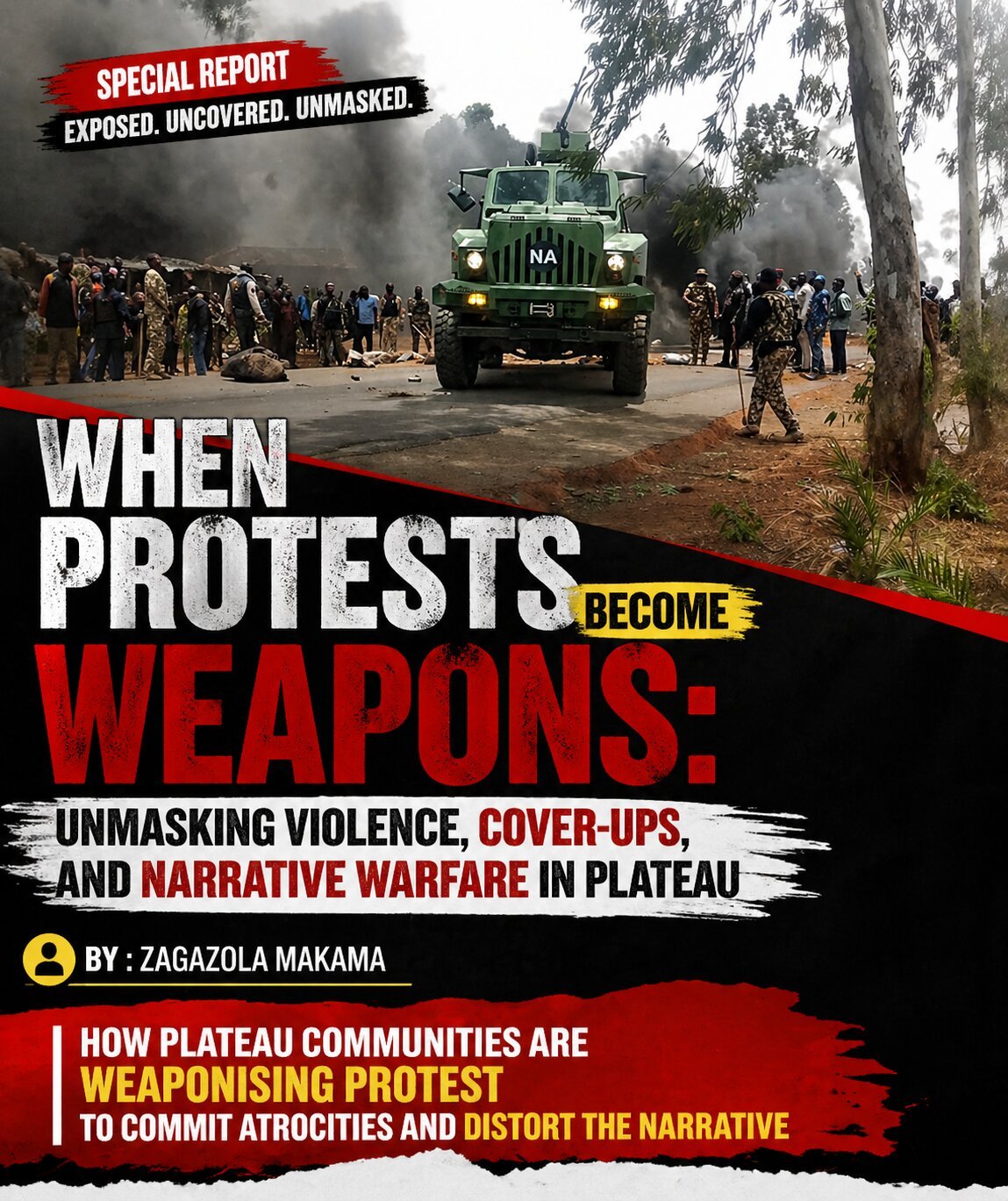
Recent developments in Plateau State reveal a troubling pattern where protests are no longer merely expressions of grievance but increasingly weaponised tools in a broader cycle of violence, retaliation, and narrative manipulation. Beneath public outrage lies a deeper structure of coordinated attacks, reprisals, and selective storytelling that shapes perception and obscures accountability.
Security analyses indicate that many of these incidents follow a recurring sequence: targeted attacks on vulnerable groups, followed by retaliatory violence, and then public demonstrations that frame the narrative in ways that conceal initial triggers or complicity. This evolving dynamic has contributed to a cycle that continuously erodes trust between communities and weakens institutional response. 1
In several documented cases, attacks on livelihoods—such as cattle rustling or destruction—have acted as precursors to larger outbreaks of violence. These acts often go underreported, creating a distorted public narrative that only highlights the aftermath rather than the origin of conflict. 2
More recent incidents show how quickly tensions escalate. Road blockades, mob attacks, and reprisal killings have been linked to prior violence spreading through informal channels before security forces can intervene, reinforcing the speed at which narratives—and counter-narratives—are constructed. 3
At the same time, protests have increasingly emerged not just as reactions to violence, but as instruments that can pressure authorities, influence public sentiment, and in some cases shield perpetrators under the guise of communal defense or grievance expression. 4
Experts warn that without addressing both the physical violence and the informational warfare surrounding it, Plateau risks entrenching a dangerous feedback loop—where each act of violence is reinforced, justified, or amplified through competing narratives rather than resolved through justice and accountability.