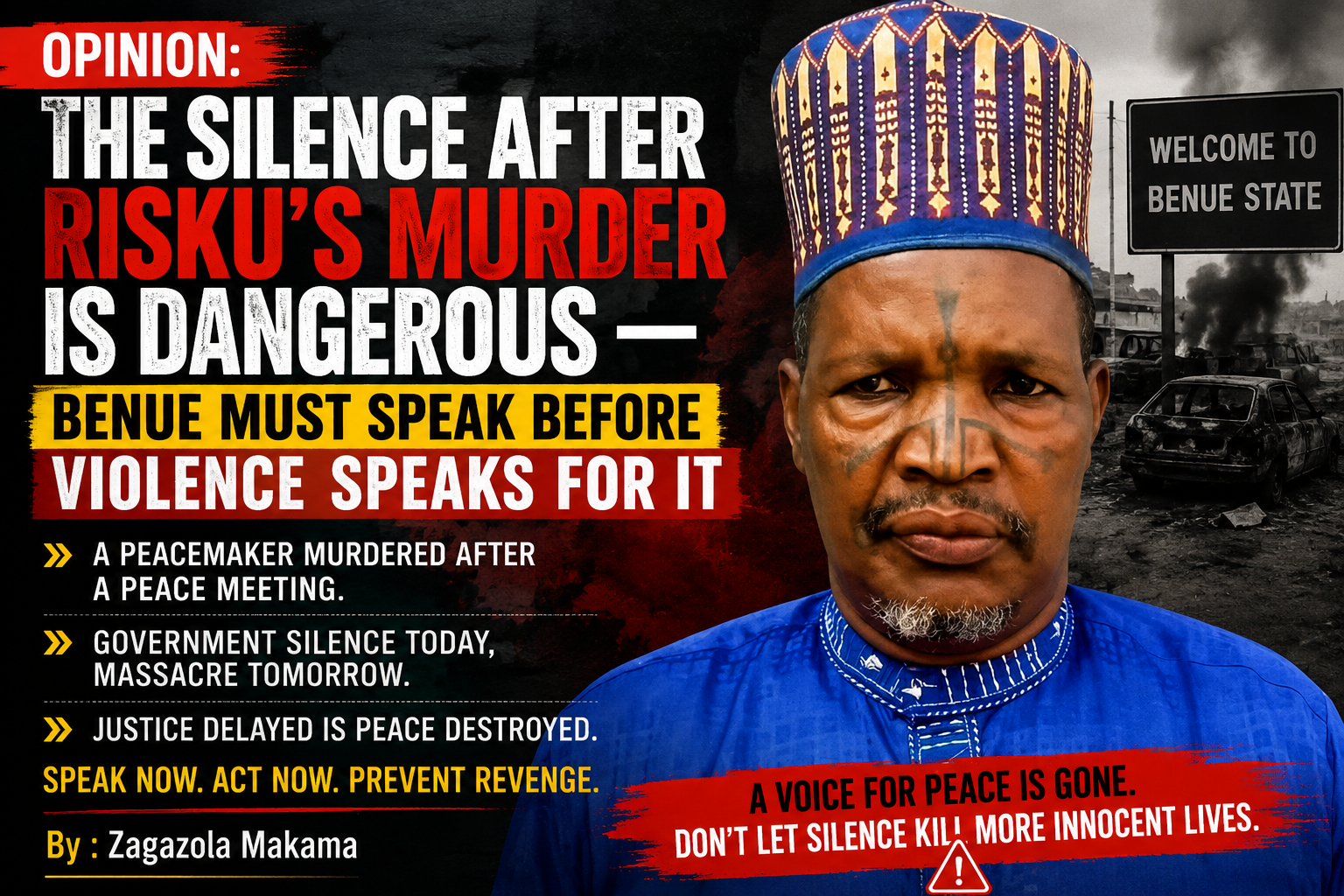
OPINION: The Silence After Risku’s Murder Is Dangerous — Benue Must Speak Before Violence Speaks for It
By Zagazola Makama
Several hours have passed since the brutal murder of the Chairman of the Miyetti Allah Cattle Breeders Association of Nigeria (MACBAN) in Benue State, Alhaji Ardo Risku, and his son, Ibrahim. Yet, what has echoed louder than the gunshots that ended their lives is the deafening silence from the Benue State Government. That silence is troubling.
According to multiple security sources, Risku was not just another community leader. He was widely regarded by security agencies as one of the most peaceful Fulani leaders in Benue State. A man who consistently stood on the side of dialogue rather than violence. He spent years encouraging restraint, persuading communities to embrace peaceful coexistence, and working closely with security agencies to prevent attacks and reprisals.
Ironically, he was murdered while returning from yet another peace meeting.If there is any definition of dying in the service of peace, this is it.Those who worked closely with him say his efforts played a significant role in keeping many parts of Benue relatively calm over the past several months.
At a time when the state had every reason to descend into another cycle of bloodshed, Risku remained one of the bridges connecting deeply divided communities. That bridge has now been targeted to be destroyed by the enemies of the state who benefits from crises.
Even more heartbreaking is the fact that Risku himself had repeatedly expressed fears that enemies of peace were after him. During previous peace engagements, he openly warned that there were individuals determined to eliminate him because of his commitment to reconciliation. On one occasion, he reportedly cancelled a peace meeting organised by a local government chairman in Benue after receiving credible security concerns about threats to his life.
Sadly, those fears became reality. One senior security official who knew Risku described his death as “disturbing, painful and entirely undeserved.” “He was a good man,” the officer said. “Throughout the years, he was never found wanting in any criminal activity. He never encouraged violence. He consistently supported every peace initiative. Ironically, peace became his death sentence,”
“This man spends years preaching peace. He convinces angry communities to embrace dialogue instead of revenge. He works with security agencies. He attends every peace meetings. He risks his own life trying to prevent bloodshed.Then he is murdered on his way home after honouring another invitation for peace talks.
In the end, his fears proved justified. The enemies of peace found him. But where were the voices of leadership? Still searching for the right press release? Or perhaps someone was calculating the political cost of condemning the murder of a Fulani man. Because these days, it appears that condemning the killing of an innocent citizen has become a political risk rather than a moral obligation.
Let’s ask the uncomfortable question. Would the condemnation have taken this long if the victim belonged to another ethnic group? That question alone should trouble every Nigerian.
Since when did ethnicity become the deciding factor in determining whose life deserves immediate sympathy?
Risku had lived in Benue for decades. He invested his energy in promoting peaceful coexistence. Security agencies trusted him enough to involve him in every peace initiatives.
Yet after his murder, official silence became louder than the bullets that killed him. What exactly are we telling other peace advocates?
Infact, hypocrites who tried to justify the killing are saying that he was killed by his own people in order to truncate the relative peace in the state.
The greatest beneficiaries of this silence are not grieving families. They are those who profit from conflict. Every peacemaker removed from the equation creates more room for extremists to recruit, manipulate and divide communities.
This is how wars are sustained, not only by those who pull triggers, but sometimes by those who cannot find the courage to condemn those who do. The murder of Ardo Risku is not simply about one Fulani man. It is about whether governments will speak only when it is politically convenient.
Governor Hyacinth Alia should rise above political calculations. He has an opportunity to demonstrate leadership at this critical moment.
Leadership is not measured by how loudly one speaks during campaign rallies. It is measured by how quickly one stands with every victims, even when doing so attracts criticism. Justice has no tribe. Condemnation has no religion. Empathy should have no ethnicity.
Is every Fulani man now to be judged solely by his ethnicity? If Risku whose record of peaceful engagement was acknowledged even by security agencies could become a victim simply because of who he was, then Nigeria is travelling down a road that no responsible society should ever accept.
Criminals should be identified by their crimes not by their ethnicity. Justice must remain individual. Collective guilt has never solved insecurity anywhere in the world. It only creates new victims and fresh cycles of revenge.
This is precisely why the Benue State Government must act, not tomorrow, not next week, but now. A clear public condemnation, reassurance to all communities, and a transparent investigation would send the message that every innocent life matters equally under the law. More importantly, security agencies must move swiftly to identify and arrest those responsible. There should be no sacred cows, no excuses and no delays.
Every security formation operating in Benue, troops of Operation Wirld Stroke, Police, the Department of State Services, the Nigeria Security and Civil Defence Corps and other relevant agencies, must immediately heighten surveillance in vulnerable communities. Intelligence gathering should be intensified, confidence-building measures strengthened, and every effort made to prevent revenge attacks.
Intelligence operations should be intensified immediately because history has shown that when respected community leaders are murdered, retaliation often follows. Stopping the next killing is just as important as investigating the last one.
Benue has bled enough. If the objective of those behind this killing was to destroy the fragile peace that had held for months, then government silence only risks helping them achieve exactly that.
Zagazola is a Counter Insurgency Expert and Security Analyst in the Lake Chad Region